
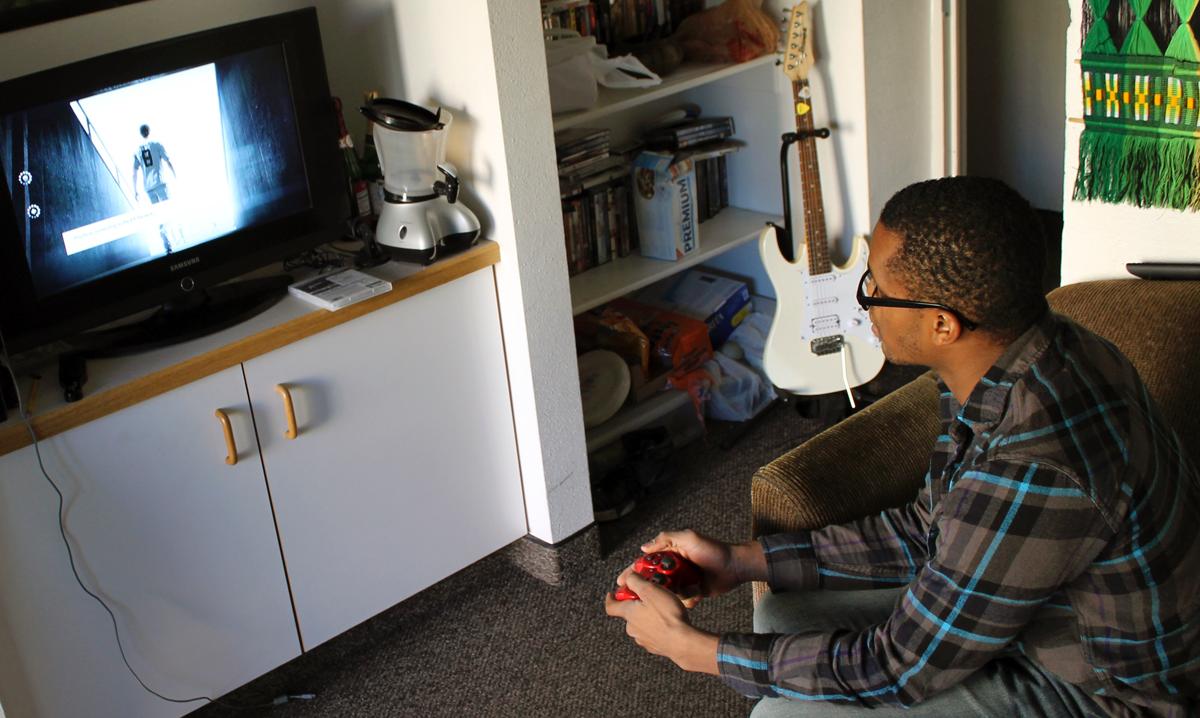
Video gaming provides positive elements
For more than 30 years, video games have advanced in both realism and popularity, and this popularity has led to a culture of millions of gamers worldwide. Some feel these gamers lose touch with the real world in their hobby – others disagree.
“In my experience, it just seems that it is a waste of time,” said Kristy Phillips, a sophomore majoring in family, consumer and human development.
Phillips said her ex-boyfriend was heavily involved in video games, and it was detrimental to their relationship.
“I would come over and instead of doing something with me or doing something together, he would spend the whole time convincing me that I needed to learn how to play ‘Call of Duty,'” she said. “He would sit there and play it forever until the point where I’d get up and want to leave. He said he’d only play for five minutes, but he’d really play for like 45 minutes or longer until I’d say I was leaving. He was a winner – let me tell you.”
Phillips said her ex-boyfriend’s focus on video games made her feel unappreciated and eventually became a factor in her decision to break up with him.
“He was always more worried about his ‘Call of Duty’ than he was about spending time with me,” she said.
Phillips said playing videogames is acceptable as long as relationships are maintained and responsibilities met.
“It’s okay to play your game, but you don’t need to play it when other people are around,” she said. “Don’t let it completely consume your life to the point where you forget about the people around you and the responsibilities you have. Some people spend more time consumed in their game than in their actual life.”
Nick Gundlah, a senior majoring in business, said he has always been a heavy gamer and doesn’t expect that to change any time soon. He said his interest in gaming doesn’t negatively affect his relationships or work commitments, but said it has led to distractions in the aspect of school.
“Video games are just what I went to because I didn’t want to write the paper or whatever,” he said. “If there had been people to go out with or if I had had some other alternative, I would have done that instead anyway.”
Many factors can lead to distractions during the semester. According to Gundlah, video games are no worse than any other diversion when it comes to a lack of productivity.
“People aren’t productive for varying reasons,” Gundlah said. “If people aren’t productive from hanging out with their friends all the time or going out partying and such, is that more justifiable or acceptable than playing video games? For me it comes down to your personal will-power and your own sense of responsibility, but gaming is not the only non-productive option.”
Gundlah said there are many different hobbies with varying levels of sociality, and participating in videogames should not be stigm
atized.
“I don’t think the stigma against video games is any more valid than the stigma against any other distraction,” he said. “I don’t think that anyone can say they spend 100 percent of their time around people – that they have no interests of their own that are solitary.”
Gundlah said there is a social aspect to gaming and many gamers share a common bond through something they are interested in. He said since starting college, video gaming has helped him foster social interaction and make new friends with common interests.
“That’s how I made a lot of friends,” he said. “It’s always been conduit for me to meet people with shared interests.”
Josh Waters, a second-year graduate student in instructional technology and living sciences, said video games have applications in education, and videogame training provides better a better transition between training an actual job.
“In military training, they develop what are essentially video games to teach flight pilots how to fly their planes without actually flying the planes and potentially crashing,” Waters said. “They can recreate the cockpit with screens instead of windows so they can practice. There is an entire field of educational gaming.”
“I think one of the things video games are very good at is providing feedback that is relative to the activity,” he said. “They are powerful educational tools because they allow the player to learn through choice. I’m in a class where I’m making an educational game about teaching basic Japanese.”
Waters said casual video games such as “Call of Duty” or “Halo” offer still an element of education.
“They’re using educational principles to help the player learn how to play the game,” he said. “There is a bizarre crossover between video game design and education. It’s fascinating.”
According to Waters, the social aspect to video games is often overlooked. He said in high school they were a key element in his social life.
“Video games were my social life,” he said. “I remember spending countless hours at friends’ houses sitting around and playing video games. I probably had group of buddies of like twelve guys. We would talk about video games and all sorts of other things we were interested in. It was always a social thing. I think people don’t see how social video games really have become. They’re just socializing in a way that has never really been seen before.”
Waters said a social stigma surrounding video games stems from an association they have with toys and a lack of understanding.
“The problem with video games is just that they’re not really understood,” he said. “There is a lot of misinformation flying around and people aren’t really interested in trying to get accurate information and really understand.”
Waters said rather than video games contributing to poor social skills, some individuals’ initial antisociality led to their interest in video games, thereby creating an association between the two which he feels is not always inaccurate.
“There are people who do fit the stereotype,” he said. “Instead of shunning them, you should probably try to understand them instead of just simply throwing a label at them. To say that video games are responsible for destroying social skills, I have a hard time seeing video games as being the major driving force of that. I think that what it comes down to is understanding people as people.”
Waters said the popularity growth in casual games for cell phones, computers and the traditional consoles will soon lead them being more widely accepted in society.
“The future of gaming is really going to shift from this small niche, goofy, nerdy thing to something that is more broad and generally accepted like television, movies and music,” he said. “Anybody could be able to be a gamer simply because they have smartphone and a DS.”
– calewp@gmail.com