
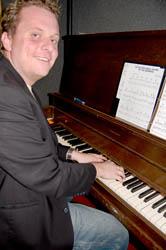
Voice Lessons at USU
For voice teachers at USU, lessons consist of more than teaching students that a doe is a deer, a female deer. Lizzy smith, senior in vocal performance, said voice lessons are about being creative and having fun.
“Singing is sometimes a big stress relief,” said Smith, who currently has six students through the university and two private students, including a 13-year-old girl. “It really takes a lot of thought and a lot of energy. It makes students be creative and really create something. It’s a really fun thing to create something beautiful, like putting on makeup or whatever.”
Smith becomes a doctor whenever she gets new students, she said, as she tries to make them musically better.
“It’s fun, I love it,” she said. “Just picking out music that fits their voice and finding out what they like. It’s kind of tricky playing the doctor at first; I have to find out what’s wrong and diagnose it.”
Smith usually has her students fill out a questionnaire to find out how much her students sing, what kind of style they like and past experience. She said she also discovers if they know basic music fundamentals, and if they don’t, she does a lot of theory work with them.
Brandtley Henderson, who also teaches voice lessons to nine USU students, does the same as well as a quick assessment each week with his students.
“I find out what state they are in at that moment,” said Henderson, senior in vocal performance and music therapy. “I find out if they are physically ill and what their week was like. Stress is going to affect their voice. Then we do some stretching and deep breathing to get the body expanding.”
Henderson then conducts warm-up exercises with his students, looks at pieces they have been working on and teaches them to use the warm-up techniques in their singing. He said the core elements and techniques students use to sing well, such as breathing and posture, are always the same, even though each voice is different.
“Each student is very different. Some have had a lot of experience, some students are very beginning,” he said. “It’s fun being able to teach new concepts to a person and see them slowly apply those concepts. The voice is a part of yourself. It’s them, their personality. After just a few weeks, they may progress. It’s very rewarding.”
For vocal performance majors to be able to teach lessons, they have to take vocal pedagogy courses 1 and 2, Henderson said. Mary-Jane Lee, senior in vocal performance said in the first course students learn all about the anatomy of the voice.
“We learn about everything from the hips up,” she said adding that includes the respiratory system, the throat, tongue, nasal cavity and each muscle and cartilage in between. The second course is comprised of applying all that knowledge, Lee said.
Smith said during the second pedagogy course, students provide seven free lessons to someone so they can practice teaching. Smith said conducting lessons was really intimidating at first, especially because her free lessons were for a friend that had taken them before from someone else. She waited two years after taking the pedagogy classes before teaching again but said she now loves the experience.
“I love it when the students have those ‘aha!’ moments,” Smith said. “They get it. They can feel it. They get done singing and they say, ‘That was fun.’ People forget that it’s fun, and singing becomes more of a science than an art. I like the moments when they are truly happy singing.”
Becky Foster, senior in vocal performance, said she likes teaching voice lessons at USU because, “It’s exciting. It’s just fun to meet someone new and have a new project and voice to see what I can come up with to improve.”
Lee said teaching is a way she can check herself and make sure she’s using the same techniques she wants her students to use.
“It’s really fun. The voice instrument is so crazy,” she said. “With a piano, you can say the notes sound crappy or that piano is out of tune. With the voice you’re improving something that is so fragile.”
Henderson said every student can become a better singer than how they were when they began lessons.
“Not every student is going to become the next Pavarotti, but they can improve,” he said.
Foster teaches two students and said even though many students will never have voices that will be heard on the radio, “I think everyone can learn how to sing better than how they started. Some people are a little more naturally gifted. Others it’s going to be a longer journey.”
Being tone deaf can be a struggle for students, which will make their singing journey more difficult, Smith said.
“It’s hard,” Smith said. “I think that (being able to hear and match pitches) is something you’re born with. If you didn’t learn it as a kid, it’s really hard. It’s like trying to learn the splits when you’re 30.”
To help students who are tone deaf, Smith said she will sing a pitch and then play a note that is higher or lower. She said she will then ask the student where the note fell relating to the first note. Some students can’t tell, she said, but with a lot of work, they can get better.
Lee said the hardest aspect of teaching is knowing that the voice is the instrument can’t switched out for anything else.
“It’s so personal,” she said. “It’s hard to tell them when something sounds bad and have them not not take it as ‘I’m bad.'”
No matter how good a student becomes at singing though, Foster said being involved in music can add something to a student’s life.
“I think that people that don’t know about music, it’s like another element that is missing,” she said. “It makes a person more well-rounded.”
Henderson said if a person can sing, they have another way to communicate with others.
“Music in general is a very good communication tool,” he said. “Some say it’s the universal language. Music communicates things to different people. If you listen to a song that’s angry, you can feel how they were feeling. In turn, through singing, you increase your own communication skills. You’re not using another instrument. You’re putting in that emotion, and the more confidence you have singing, the more you can express yourself and communicate.”
Private voice lessons are available for students every semester. For more information, contact the music department at 797-3000 or Cindy Dewey, who is the coordinator of all vocal programs at 797-3055.
-manette.n@aggiemail.usu.edu