
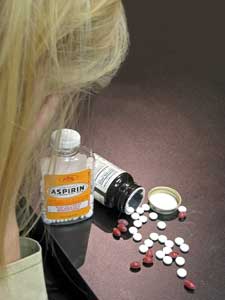
When the Blues go bad
Utah may be known for its Green Jell-O, ski resorts and fry sauce, but unfortunately the beehive state is home to one of the highest suicide rates in the nation.
According to the Violence and Injury Protection Program, Utah holds the record with one suicide every 28 hours. According to a study conducted in June of 2001 by Express Scripts, a pharmacy benefit management firm, more Utahns take Prozac-style drugs than any other state in the country. College campuses are not an exception.
Mark Nafziger, a staff psychologist at Utah State University for 15 years, said in the last 40 years, the onset age of depression is declining and the suicide rates have tripled. He said it is not uncommon for adolescent or college-age students to be clinically depressed and taking antidepressants.
“Suicide [is now] the second leading cause of death nationally for college students,” Nafziger said.
More than 90 percent of the people who complete a suicide have a psychiatric diagnosis of some kind, he said, the three most common being mood disorders, eating disorders and/or substance abuse.
Because depression is one of the most common forms of mood disorders, Nafziger said there is a controversy as to whether antidepressants play a role in suicide.
He said antidepressants are often used as something to blame by the distressed parents or family members of someone who has committed suicide, rather than blaming the depression itself.
A second reason he said antidepressants may be blamed is because a person is actually more likely to commit suicide when they start feeling a little better.
“While a person is depressed, they don’t have any energy or emotion … but sometimes if somebody has been in that state and then starts to feel better, they have not recovered … but they are having more physical energy and if the problems still exist,” he said. “Sometimes they have the drive to plan and carry out a suicide.
“Sixty years ago, the average age of onset for depression was in the 30s, but now it’s not rare at all for adolescents to become clinically depressed,” Nafziger said. “The rates of depression have gone up as well; it’s probably 10 times what it was 60 years ago.
“I’ve even heard of people giving Prozac to dogs.”
Nafziger said depression is common among college campuses across the country and Utah State is no different, though the rates of suicides at USU are lower than the national average. He said religion may play a role in the decline of suicide.
“There are people who come in here and say ‘I am thinking about suicide, but I would never do it because it’s against my religious beliefs,'” Nafziger said.
Because a large percentage of Utahns are members of The Church of Jesus Christ of Latter-day Saints, many jump to a conclusion that is opposite to this example. Some believe the high expectations and pressures associated with the church cause its members to become depressed and subsequently, commit suicide.
However, Sterling Hilton, a professor at Brigham Young University, and his colleagues investigated the relationship between suicide and religion using the 1991-1995 death records combined with data from the LDS church and the Census Bureau and found no correlation.
“No evidence suggests that church demands and pressures on its members account for the high suicide rate in Utah,” Hilton said.
They found suicide rates in each of the four age categories were lower among active members of the LDS church than among less- active LDS members, nonmembers and males in the general U.S. population.
“These results provide evidence that a low level of religious commitment is a potential risk factor for suicide,” Hilton said. “If the observed association is real, then it gives us another piece of information that helps us understand suicide.”
Hilton said the findings are not unique to the LDS church, but can apply to many religions.
Though the debate on what role religion plays in suicide may never be conclusive, there is an evidential difference when it comes to gender.
According to the National Institute of Mental Health, women are twice as likely as men to experience depression. However, Nafziger said males are more likely to complete the suicide than women.
NIMH states on its Web site that women are more likely to be depressed because of premenstrual syndrome and from some forms of birth control.
The Psychiatric Times has speculated as to some of the reasons for gender differences when it comes to suicide. They state on their Web site that women have more help-seeking behavior while men tend to be more violent and have more frequent use of firearms. The site also states that women have more of an intent to change behavior, rather than a suicidal intent.
For these reasons, women may be easier to talk to and provide help for, however, Nafziger said it is important for students to get help if they believe they or someone they know is at risk.
Nafziger said students may think if they mention something, or say something about suicide, they might trigger it, rather than prevent it, but this is actually false.
“Most people who are depressed have had suicidal thoughts or ideas. There’s not going to be anybody who thinks, ‘Oh, I hadn’t thought of that.’ That’s not going to happen,” Nafziger said.
Most people who are thinking about it will be relieved to have a chance to talk, or they will refuse, but it’s not going to hurt to bring it up. Nafziger said the main thing they recommend is that students be sure to not take too much responsibility. He said students can make appointments for roommates or friends and come into the office with them.
“Working with people who are suicidal is not easy and it’s not fun, and we have training in doing it,” Nafziger said. “So people who don’t have any training need not remain in the position of trying to be that person’s counselor. People have gotten into really bad positions of doing that.
“If somebody is really at risk, you need to tell somebody,” Nafziger said. “You need to bring more people into the loop, then that person won’t feel so alone.”
The Counseling Center has a full staff that is free to all students who are taking at least six credits. To contact the Counseling Center for more information or to set up an appointment, call 797-1012.
ETippetts@cc.usu.edu