
Where are student fees going?
The difference between tuition and student body fees rarely crosses students’ minds while they are paying their fees, but the payback for the two is completely opposite.
While tuition allows students to attend classes and be taught by professors, student body fees help provide the services students use at the university outside of class time. These are both important to USU students and understanding what students get from fees can give them a better idea of what is available at USU.
The $285.50 student body fee that is paid for a student taking 12 credits is divvied between nine areas that serve students. These include activities, buildings, athletics, buses, health, music and theatre, computers, recreation and the library. Each area has a set percentage it receives, and in order to increase this, representatives must go through the USU Student Fee Board, which is made mainly of students.
The largest percentage, approximately 23 percent, goes to building fees. This $66.50 is split into three categories: $28.50 goes to help pay off bonds for the new housing unit on campus, the TSC and the parking terrace; $32 goes toward bonds for the stadium and the Spectrum; and the remaining $6 is used for maintenance of the student center, mainly the ASUSU area, according to TSC Director Eric Olsen. He also said the expense of all activities in the TSC such as the Howl, movies and other dances are figured into this student fee in order to provide students with as much programming as possible.
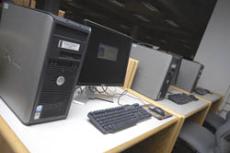
Twenty percent, or $57, goes to the computer fee. Of this, $34.70 is put toward the operating costs of the 10 open-access labs on campus, $10.30 helps to replace computers which are on a three-year replacement cycle, $6 is used for central services such as Internet access, $3 is for registration service on Banner, $2.50 buys media to enhance the classroom and 50 cents goes to assistive technology.
Athletic fees are next with 19 percent, or $53.25. Associate Athletic Director of Business Operations Ken Peterson said the money that comes from student fees is combined with other income the athletics department receives. This is essentially a “melting pot,” and Peterson said they then use the money according to the budget they have and the needs of the year.
In fourth place is the health fee, which is 12 percent of the total student body fee. This $35 is also combined with other income the department receives. Jim Davis, director of the Student Wellness Center gave numbers showing that about 82 percent of this goes to help pay salaries and benefits of those who provide the health services, including student employees. The remaining 18 percent pays for operating costs, goods to resale and a fee to be able to accept student credit cards.
The activity fee is next with ten percent, $27.25. This is divided into two sections: the tri-weekly publication of The Utah Statesman and student body activities. The $1.50 for the newspaper is used mainly to keep the computers up-to-date, said Jay Wamsley, adviser of student publications. The remaining $25.75 is combined with a small amount of other income and then divided between fixed costs, 63 percent, and budgets for the student government areas and other entities they support, 37 percent. These fixed costs include salaries for those working with ASUSU, those in student government, basic operating costs, fall leadership, computer repair and replacement, publicity board and spirit squad support.
Campus recreation gets $19.50. Campus Recreation Director Kevin Kobe said this is divided into $1.50 for Fitness Center repair and replacement and $19.50 for intramurals and club sports, the HPER and Fieldhouse, and the Outdoor Recreation Center.
These are mainly “labor and operating expenses,” Kobe said.
The library and bus fee are each $11, or 4 percent each of the total fee. Alden Erickson, Aggie Shuttle supervisor said the bus fee goes into a main fund where it is mainly used for maintenance, fuel for the buses, and to pay off the lease on the five new buses that were purchased at the beginning of this school year. Erickson said this fee of $11 is one of the lowest in the nation for student transportation. With this fee, students are able to use the Aggie Shuttle service at no charge.
The library fee is divided into three sections: $6.00 going to buy books, $2.75 for the library support system which provides access to resource, and $2.25 to support the library electronic resources, said Betty Rozum, associate director for Technical Services.
The remaining $5 goes towards music and theatre. This 2 percent is divided between music, theatre and band. Jay Greene, of the Budgeting/Information Office for the College of HASS, said $2 is given to each the music and theatre, and the remaining dollar is given to the marching band to help purchase new uniforms and instruments.
These fees are subject to increase each year if the departments feel there is a need. They must present their propositions to the Student Fee Board, which then votes to approve or disapprove the increase. ASUSU Director Tiffany Evans said the board analyzes service in conjunction with students and how they can provide the best possible service to students. As the board is made of students, it helps to provide a check and balance system to make sure these increases aren’t extravagant and unnecessary.
While students may feel their fees are simply an added cost, it allows them to have access to countless entities across campus and to be able to use resources to succeed in their classes.
-albaugh@cc.usu.edu