

Wildlife on the move UDOT gets $9.6M to upgrade crossings
A stretch of U.S. Highway 40 known for frequent wildlife collisions is getting a safety upgrade. With $9.6 million in federal funding secured in January, the Utah Department of Transportation and the Division of Wildlife Resources are working together to implement and retrofit safety improvements to protect both motorists and migrating animals.
The federal grant funds infrastructure in rural communities, and the improvements will take place between Starvation Reservoir and Strawberry Reservoir in Duchesne and Wasatch Counties. According to Matt Howard, UDOT natural resource manager, three considerations led to the selection of this area.
“We have a lot of color data from our partnership with the Division of Wildlife Resources, and those colors send out a signal up to every two hours, and so it gives us very precise data about what animals are doing in that area,” Howard said. “We also have a lot of carcass removal contractors who pick up carcasses, and they add the points to an app that we use to track, and we have crash data from law enforcement.”
Alongside meeting the guidelines of the grant, Howard said this rural spot showed a real need for the improvements.
“It is a hot spot for collisions and also a barrier for wildlife movement,” Howard said. “Anytime you build a road between a habitat, you’re going to have animals that are trying to move around.”
According to the UDOT website, 60% of the crashes in the area over the last seven years have involved animals. Howard said the danger for the animals is furthered by the type of vehicles frequenting the highway.
“This is a major corridor for oil trucks going from the Uintah Basin, where there’s a lot of oil and gas exploration, to Salt Lake, where the refinement happens,” Howard said. “So we had all these oil trucks continuing pretty steady traffic, and they’re not able to swerve or slow down for animals.”
Howard said the oil traffic in the area is projected to double in the next 10 years, which created urgency behind the project.
The funding will be used to build 23 miles of eight-feet-tall fencing along the highway, retrofit three existing underpasses and add one new underpass.
“Although wildlife fencing without wildlife crossings can be a big barrier to movement, and 23 miles is a lot of fence, there are going to be some very specific targeted areas where the one wildlife crossing structure is going to be installed, and then those other existing structures will be fenced to,” said Makeda Hanson, DWR wildlife mitigation initiative coordinator. “That will really focus animals to those areas.”
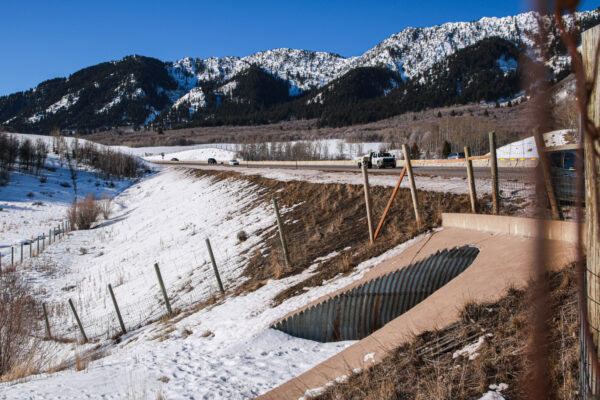
Utah Department of Transportation wildlife crossing located at mile marker 14 in Sardine Canyon on Feb. 27.
According to Hanson, the three existing underpasses are being updated in order to make it easier for wildlife to recognize them as safe and use them.
“Wildlife crossings can be scary for wildlife to use, especially initially — and so trying to remove any unnecessary obstacles to wildlife to help them,” Hanson said. “Some of the plans are just to fix some of the substrates on the wildlife crossing so it’s a little bit more approachable for wildlife — so smoothing out the dirt on the bottom a little bit or just adding that fencing to the sides to make sure the animals know that that’s a good place to cross.”
Hanson said the highway is a barrier between habitat and wildlife, but there are other risks without the fencing and underpasses.
“With wildlife-vehicle collisions, there’s a higher proportion of reproductive females that are healthy that are getting killed on roadways than other types of mortality that our deer are experiencing,” Hanson said. “It’s really important for us to try and make sure that we’re protecting that part of the population that’s really leading to healthy, productive populations.”
According to Howard, another risk without the improvements is some animals won’t even attempt to cross the road.
“That’s shown in our data in multiple different locations — that the majority of animals when approaching a road will never even attempt to cross it,” Howard said. “So, if you have a good habitat surrounded by two or three roads, that habitat may never be accessed by animals, and that’s a loss for the herd, and that’s a loss for people who like to see animals, and it harms their ability to survive harsh winters.”
According to Hanson, avoiding the structures is important for wildlife to use them and understand they’re safe.
“Try and avoid human activity near those structures. If there’s a lot of activity from hiking or whatever other human activities there are, that could discourage wildlife from using those areas,” Hanson said. “So, if you can avoid those, that would be best, especially during the fall and spring when we see a lot of migration.”
This isn’t the first project UDOT and DWR have taken on recently to improve wildlife safety across the state. Most recently, in 2023, UDOT was awarded around $5.5 million to construct new underpasses and fencing in Kanab along U.S. Highway 89.
“We call it a wish list: projects that we think are pretty shovel ready — that we could implement a project right away if we got the money,” Howard said. “That’s something that we present to the state legislature every year, and it’s something that we work together with the Division of Wildlife Resources to come up with.”
Moving forward, UDOT and DWR hope to secure funding to work at the Echo junction, where Interstate 80 and Interstate 84 meet by Echo Reservoir.
“That’s one the bigger hot spots in the state, and it’s where we think we have some good ideas of how we can resolve the problem,” Howard said. “We just need the funding to do it.”
Hanson encouraged Utah residents who want to help the process to download the Utah Roadkill Reporter app, available for iPhone and Android users.
“If you see a road kill, if you can safely record that, or once you arrive at your destination, you can record the animal and put an approximate location on a map,” Hanson said. “That really helps us understand where those hot spot areas are, so where we’re seeing the highest number of collisions, to try and prioritize an area specifically for wildlife crossing.”
Howard also suggested interested residents write to or call the state legislature.
“Let them know that this is something your community is very passionate about,” Howard said. “When we think about putting these crossings in, it’s not just public safety or worrying about the number of animals that actually get hit. We’re also just trying to grow bigger, healthier populations of animals in our state.”