
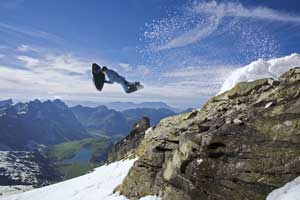
Winter’s Wide World: A guide to some alternative winter sports
Until the recent snowfall, it seemed summer would erase winter dreams for Logan residents, but students can again experience the joy of winter in the Cache Valley and up Logan Canyon.
“The snow pack is excellent in the canyon,” Paul Bowman, the rental and retail supervisor for Utah State University’s Outdoor Recreation Center (ORC), said.
The ORC offers a variety of options to help students enjoy the winter through March and April, Bowman said. Beaver Mountain is scheduled to be open until ???, but for those students who don’t have the cash or the gas to make the trip, there are a number of sporting alternatives to make the winter cold feel worthwhile.
The Air Board:
The Air Board is one of the most recent inductions into the snow recreation family. According to its Web site (www.airboard.com) the Air Board is a “body board for the snow.” The new sport is a hybrid between the hard body sleds and over inflated inner tubes which frequently populate sledding hotspots like Old Main Hill. Though the boards are gaining in popularity, some people may not take to them right away.
“You might have a negative reaction [to the boards] like I did at first,” Brown said.
The boards resemble the water torpedoes pulled behind speed boats in the summer. They are basically inflatable sleds with rubber runners on the bottom and handles to grip. The performance of the boards, however, outshine traditional sleds with some riders clocking in at 88 mph on professional ski hills.
The board is available at the ORC. Rental cost is $8 a day or $10 for the weekend. The rental includes a helmet to help prevent downhill injuries.
Cross-country skiing:
An old friend to the underground world of alternative winter sports is cross-country skiing, which takes the familiar downhill skis and applies them to a much slower, sight-seeing type sport.
Phoebe Zarnetske, a graduate student in the College of Natural Resources, remembers being able to take her skis just outside her front door into the wooded area of her hometown in Storrs, Conn. Zarnetske has been skiing cross-country since she was five years old.
“The sport is pretty user friendly,” she said.
Her friends from Colorado recently visited and were able to pick up the basics during their day-long excursion.
Though time spent with friends or in the quiet of the outdoors may draw Zarnetske to cross-country skiing, other students might find the slow gliding hike less-appealing. Zarnetske said that those people should try cross-country skiing with friends and make fun of each other trying to go down hills. Cross-country skis don’t have metal-edged sides for turning like downhill skis.
Skate skis are the type of skis being used in Italy right now for the biathlon. While all of the skis provide ample exercise in the frigid outdoors, both Brown and Zarnetske both say the skate skis will give you the best work out. Both telemark and skate skis are available for rental at the ORC.
Split Boards:
Next year, the ORC will bring in split boards. These newly developed boards will allow snowboarders unfamiliar with skiing to litterally split the board in half to ‘ski’ to their desired spot. After arrival, the split board can be put back together and used as a traditional snowboard.
The boards were invented by Brett Kobernick in 1994, Robert Athey, backcountry ski expert said. Kobernick had taken a hacksaw to an old snowboard and connected the two pieces with a series of hinges and ski touring parts. Split boards are now produced by four companies including Voile, Burton, Duotone and Prior Snowboards.
The boards have a lot of appeal for backcountry snowboarders like Skylar Christensen and Joshua Bowles, both students at Utah State University. The two ride at Beaver Mountain together frequently, but enjoy going off the beaten path.
Right after the first snowfall of the winter last October, Bowles and Christensen set out on their own at Alta Ski Resort (which caters to skiers only during the season) to find a great downhill experience.
“You have to really work to hike,” says Bowles. “It was like sweet revenge [to be on a skier only resort]. You get the rush of knowing you did all the work.”
Snowshoeing:
Hiking the back hills of Cache Valley becomes a year-round activity with a good pair of snowshoes, also used by backcountry skiers and snowboarders.
“I enjoy hiking in the summer but it’s hard to do when there’s snow outside,” Ryan Allen, a senior majoring in Spanish, said.
Now, Allen said, he has discovered the joys of snowshoeing. Though he has to compete with the occasional snowmobile, Allen finds there are even less people hiking than in the summer; but he admits that snow hiking can be more difficult than traditional hiking.
“I tried to take on the mountain last week and it kicked my butt,” he said.
One of the benefits of snowshoeing is that, unlike summer hikers, winter hikers don’t have worry about switchbacks or erosion. However, avalanches can always pose a threat.
“Go with people that know how to travel safely,” Bowman said, “or, take an avalanche class at the ORC.”
Both Bowman and Allen warn people to watch out for unfamiliar or danger-suspect areas immediately after a big snowfall. Even a “blue bird day,” as Bowman calls warm, peaceful days that follow large snowfalls, may not be as picturesque and innocent as it looks. When fresh snow hasn’t bonded to the old snowpack, avalanches are common. Most avalanches that threaten people occur on small slopes of 100 meters or less.
Bowman suggests a few rules to remember for anyone engaging in winter sports: Dress appropriately; take a little extra food if traveling an unfamiliar area; always tell someone else where you’re going for the day. Avalanche transmitters, also called beacons, are useful but should be considered only as a last resort.
For more info on some valley hiking tails, visit www.utah-trails.com. For more information on winter sport rentals and upcoming events, visit the ORC Web site at www.usu.edu/orc.
-jfullmer@cc.usu.edu