

World Mental Health Day promotes awareness
Students and employees gathered around the TSC fountain on Oct. 7 for Utah State University’s annual World Mental Health Day celebration. The event featured music, massages, puppies and a steady flow of people moving from table to table in search of both relaxation and resources.
The event, held from 11 a.m. to 2 p.m., brought together multiple departments in a collaborative effort to promote mental wellness across campus. Alyssa Jensen, employee wellness manager with Human Resources, said the activities were intentionally designed to create a positive atmosphere while connecting participants with meaningful resources.
“Our goal is to share resources that are available to students and employees and help highlight the importance of taking care of our mental health with fun, engaging activities,” Jensen wrote in an email to The Utah Statesman.
The USU Employee Wellness Program, Campus Recreation and the Counseling and Prevention Services, or CAPS, offices coordinated the event as part of the university’s Aggies Thrive initiative. According to Jensen, the day’s lineup included an information and resource fair, a hope walk, chair massages, self-care kits, a drum circle and a PAWS-itive impact activity with dogs from the Cache Humane Society.
“We decided that these activities would draw attention and make it easy to connect with others to start conversations around mental health and its importance, they also encourage us to take time to stop and relax and participate in activities that increase serotonin, or the feel-good hormone,” Jensen wrote.
The sound of hand drums filled the air as participants gathered in a loose circle near the fountain, playing rhythms that carried across the TSC patio. Nearby, volunteers from the USU Music Therapy Student Association invited students to learn how music can support emotional well-being.
“There’s a lot of definitions of music therapy,” said senior Anna Small, special events coordinator for the association. “It’s basically like regular therapy but with music as the main medium.”
Small said music therapy uses rhythm, melody and songwriting as tools to help clients manage emotions, cope with illness and connect with others. She and senior Garrett Andrews, the club’s treasurer, said students in their program work with a variety of populations, including children and adults with disabilities, hospice patients and those with dementia.
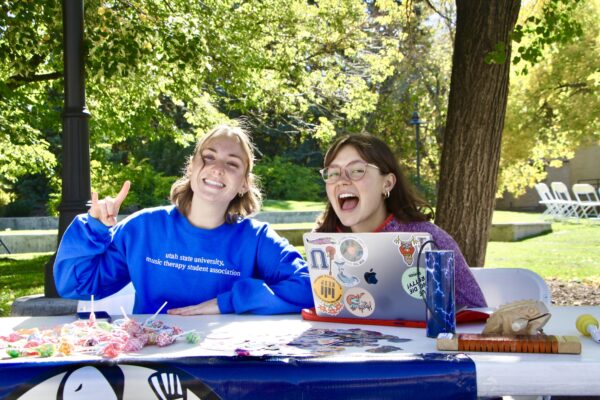 Hadley Sintay
 Lily Buxton and Mallory McAllister sit behind a “Utah State Music Therapy” table during World Mental Health Day on Oct. 7.
“We’re using music usually to achieve non-musical goals. It might be to help someone reminisce, to promote relaxation or just to give them a safe place to express themselves,” Andrews said.
Across the patio, students gathered around a table hosted by Campus Recreation. Associate director of programs and assessment Reed Phinisey said recreation and mental health are deeply connected.
“People find mental health benefits in almost any forms of recreation,” Phinisey said. “We don’t try to bottleneck it to say you have to go to yoga class. It’s really finding your outlet that helps you manage your stress and your anxiety.”
Phinisey said Campus Recreation often partners with CAPS to promote both physical and mental well-being.
“We really just try to be a partner for any of those dedicated professionals that do specifically practice mental health,” he said. “To kind of just be a good partner and create more awareness for those resources.”
Nearby, wagging tails caught attention as students surrounded a police officer with his canine companion. USU Police Officer Shane Nebeker attended the event with community engagement and crisis response K-9 Officer Sage, a therapy-trained police dog known for her comforting demeanor.
“Literally, her job up here is just to make people smile,” Nebeker said. “It’s pretty interesting to walk around with her and see how she brightens people’s days.”
Nebeker said Sage regularly visits busy areas like the TSC, Huntsman Hall and housing complexes to help ease student stress, especially around finals.
“I’ve seen people that probably have had a really bad day and just completely uplifted because of their interaction with her,” he said.
Throughout the event, students lined up for free 10-minute massages, collected self-care kits and spoke with representatives from campus and community organizations, including CAPS, the USU Sexual Assault and Anti-Violence Information Office and Bear River Mental Health.
According to Jensen, World Mental Health Day is one of several annual efforts by USU to support emotional well-being among both students and employees. For faculty and staff, the Employee Assistance Program offers free counseling and other resources for them and their family members.
“For students, CAPS provides counseling and therapy options as well as immediate help during a crisis,” Jensen wrote. “In addition to the resources through CAPS, there are several other departments around campus with resources including the USU Library, the SAAVI Office, the Departments of Social Work and Psychology, and the Sorenson Center for Clinical Excellence.”
According to Jensen, the university plans to continue sharing information about these services throughout the year, including during the annual Health & Wellness Expo held each spring.
“In this age of instant information, we are constantly being bombarded with messages that influence us in all directions,” Jensen wrote.
She also mentioned mental health is just as important as physical health.
“Taking care of ourselves in all facets is vital—just like we would visit a doctor for our physical health if we didn’t feel well, we need to have the same urgency to seek help for our mental health,” Jensen wrote.