

Wuda Ogwa project heals land, water, culture
Brad Parry’s great-grandfather survived the Bear River Massacre by “lying down on the ground and playing dead.” This is a story Parry’s grandmother has relayed to him many times while standing at the site together.
“It has a special meaning to me just because that was our family that was there, and they survived,” Parry said. “When we used to go there, it was a really sad place.”
In 1863, the United States Army killed hundreds of the Northwestern Band of the Shoshone Nation. Over 150 years later, Parry’s life mission is to lead the restoration of the Wuda Ogwa, the Bear River, cultural site through collaboration, togetherness and culture.
This undertaking has attracted hundreds of volunteers and partner organizations. Involvement has only grown — starting with about 400 volunteers during the first event and nearly 900 people showing up for the most recent tree-planting day. Parry said they had to space the event over two days to account for these numbers.
“As the positivity grew, the place has changed for me,” Parry said. “It’s a special and sacred place, but I’m excited with what we’re doing.”
This project of healing is a wide-reaching venture. It entails planting native flora, removing invasive Russian olive trees, installing wildlife cameras, conducting roadkill studies, building a walking trail, conducting hydrological and geomorphological studies and more.
According to Parry, one of their main goals is to restore the wetlands of Battle Creek, which would have been known as Beaver Creek at the time of the massacre. Parry said beaver dams keep the water clean and biodiverse.
The restoration project has expert input from hydrologists, anthropologists, engineers and geologists who study the rocks, soils and hot springs.
“The professional people that come work on it have just told me this is their favorite project just because it means something,” Parry said.
Among the many partner organizations is Utah State University. Natural resources classes aid in studying wildlife crossing options and setting up game cameras, which have captured images of coyotes, raccoons, bobcats, deer and more.
Cristina Chirvasa is a graduate student at USU who is designing her Ph.D. project in collaboration with the Northwestern Band of the Shoshone Nation and the restoration at Wuda Ogwa. She also works as USU professor Eric LaMalfa’s lab manager to coordinate undergraduate researchers.
“We’re just trying to see what’s at the site and how that’s going to change in response to restoration,” Chirvasa said. “Our undergraduate research technicians can just pick a topic they’re interested in, and we can work with them to make a project around it.”
Student projects range from studying reptiles to analyzing bird diversity and using sensors to collect bat echolocation data. The students are also working to help reestablish sego lilies.
“It is our state flower but also a very important cultural resource for the Northwestern Band,” Chirvasa said. “We’re trying to establish that so that the tribal elders can use it to educate youth.”
Anthropologic studies have shown Indigenous presence helps sego lilies flourish, according to Chirvasa, which is why undergraduates are mimicking how Indigenous peoples would harvest the flowers.
Rios Pacheco, the cultural analyst for the Northwestern Band of the Shoshone Nation, holds ceremonies to retain respect for the land and the ancestors.
“Usually what we do is we have a tobacco offering to the land,” Pacheco said. “We take care of all the ancestors that still have their spirits on the land. I make sure that all our cultural understanding is explained to those that are working with us and those that come out and volunteer with us and that we show respect for what we’re doing.”
According to Pacheco, removing invasive plants will increase the populations of birds, insects, frogs, snakes, pollinators and other native animals.
“What our project does is bring people together,” Pacheco said. “It allows us to not just share the culture but to share knowledge of nature.”
The restoration project is a good opportunity to teach the youth how native plants are used for food, medicine, cords or clothing, according to Pacheco.
“Most of all, we’re making it a place where people can come and re-energize themself because it will be a place of calmness,” Pacheco said. “Where the water flows, people lose a lot of their stress.”
The water from Beaver Creek flows into Bear River, one of the largest tributaries that feed into the Great Salt Lake. Pacheco said the restoration of native plants along the creek will help filter clear water downstream.
“It’s a good learning lesson for other management of different waters, rivers and anything that flows — creeks that flow — into the Great Salt Lake,” said Maria Moncur, the communication director of the Northwestern Band of the Shoshone Nation. “Another goal is that we’ll return at least 10,000 acre-feet of water back to the Great Salt Lake each year, and that’s a modest estimate.”
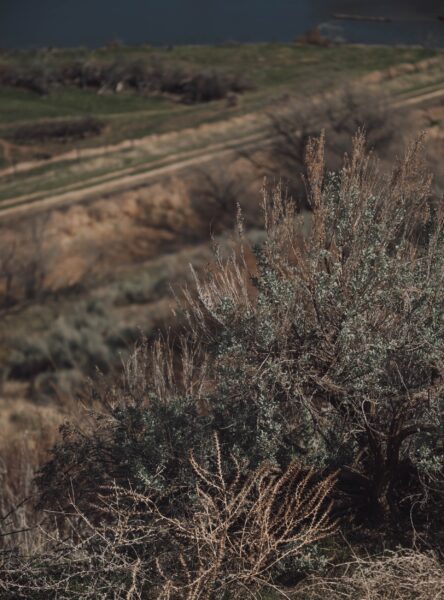 Hazel Harris-Staples
 A sagebrush plant on the Wuda Ogwa restoration project land, as seen in April 2025.
Moncur married into the tribe 27 years ago. She decided to join the restoration project due to her professional background and experience.
“It’s more than just what happened 163 years ago. It’s hope for the future,” Moncur said. “This community, working together, can accomplish anything.”
Moncur said partner organizations have been valuable to the project and in creating strong, lasting friendships.
“Those partnerships have been invaluable in just continuing getting the science feedback and drawing the line between cultural and scientific,” she said.
According to Parry, these partnerships are what make the project so successful and widespread.
“People that come out and volunteer just say they feel welcomed, and we’re pleased that they’re there,” Parry said. “People ask me, ‘Why do you have so many settler volunteers? They kind of pushed you out.’ We’relike, ‘No, we live among them. They live among us.’ We don’t carry that grudge. We want to promote that this land is togetherness and that this land is rebirth and regrowth.”
Parry encouraged volunteers to remember the trees they planted by pinning each location on their phones.
“We want, in 20 years, people coming back because they feel connected,” Parry said.
This connection is what lets the project hold deeper meaning for those who participate, Parry said. He hopes volunteers will bring their future kids and grandkids to the trees they planted.
“Everyone’s going to forget my name in the future, but this project will still be there, and that’s the goal,” Parry said. “I don’t care if they know who started it. It’s just all about the future.”
As Pacheco said, “It’s a restoration for not just nature, but for people.”