

36 seasons
It’s the first thing people notice when they walk into the Spectrum.
Orange seats? Where on earth did that come from?
The stories range from the school ran out of money and was forced to pick up the left-over seats from the D.I., to the colors being a by-product of the 70s … and something that maybe should have stayed in the 70s. Or, on the other side, people have said that the seats have the beauty of the colors of Cache Valley in the fall.
Whatever story you have heard, odds are, it isn’t true. Few people now know what inspired the uniquely-colored seats.
“Originally [the seats] were going to be blue, then the thought that in the winter time – it’s winter a lot in Logan – they wanted it to be a warmer feel when they went in,” said Cedar City Mayor Gerald Sherratt who at the time was the vice president of student relations.
Sherratt said using fall colors was originally the architect’s idea. The architect then came up with the idea to vary the colors, putting the colors in a computer and having it randomly generate which color went where in the seating, something, Sherratt said, people can’t find anywhere else.
While the color of the seats is probably one of the more unique things about the Spectrum, it isn’t the only thing the opposing teams remember when they leave the court.
What really brings the Spectrum to life is its fans.
“It’s a great home court,” men’s basketball coach Stew Morrill said. “Sometimes it’s unbeatable as far as the atmosphere. What I like to do is see it at its best night in and night out. The atmosphere is always good, but sometimes it’s great.
“When it gets going like crazy it’s just hard to hear, it gives you goosebumps and as long as I’ve been coaching it can still get to you. That’s probably the thing I enjoy about [the Spectrum] the most, when we get to that volume level.”
Unlike many other arenas, students can sit right up next to the court. Al Lewis, the Aggies’ play-by-play radio announcer, said that’s something that helps the students get more involved. And, he likes the how creative students can get at games. One thing he said stood out in his mind was one game against BYU when a couple fans dressed up like the opposing coach’s sons.
Lewis said the creativity of the fans was something that originally attracted Morrill to USU.
“Stew even said the reason he took this job was he knew how good the home court atmosphere was,” Lewis said. “He got a great kick out of the students. When he coached for Colorado State he came here and the students called him Yogi and his assistant … Booboo, because there was such a difference in height.”
Over the past couple years, students have been turning out in record numbers to attend the games, something Craig Hislop, the news director with Utah Public Radio, said is mostly due to the teams Morrill has put together.
In the last eight years that Morrill has been at Utah State, he has had a 109-10 record in the Spectrum.
“Before [Morrill] was coach maybe the best year in Aggie history was 25 wins,” Hislop said. “Now, that seems like an average. The students really seem to have taken over and gotten involved in that winning.”
Other schools, like Duke, that have a tradition of a tough home court advantage, have nothing more, in Hislop’s opinion, than the Spectrum has.
“I don’t think their environment is any better than the Spectrum now,” he said. “The students are involved in the game, and seem to understand the game and get involved. It’s just a different place to watch a game than it used to be. There’s a lot of people that care about this program, and it shows at the games now.”
Dedicated on Dec. 1, 1970, the Spectrum was a step up for Aggie sports. However, despite the improvement over the Fieldhouse where USU had played its basketball games before, for some people it wasn’t exactly what they wanted.
Men’s basketball coach LaDell Anderson led the Aggies through the first couple years in the Spectrum said he loves the Spectrum, but where it was built was not something he agreed with.
“It was one of the most stupid mistakes, if you will, of building an arena that the university ever made,” Anderson said. “I love Utah State. It’s my alma mater, where I coached, [and where] I was athletic director. [But] I was really upset at the situation.”
Anderson said he thought the Spectrum should have been built down near the Stadium because there isn’t enough parking close to the Spectrum. With a cemetery on one side and fields on the other, there is no where to park without having to walk uphill. Something that would not increase ticket sales.
Despite the location, Anderson said building the Spectrum changed the face of Aggie basketball.
“We were able to bring teams in there now, then, that had been very difficult to bring them in,” he said. “We had a final eight team play in that arena. We were able to play Ohio State, Missouri, and Iowa State. We brought a lot of wonderful teams in there to play. Half the PAC 10 were able to play in there.
“The overall feeling [was] that we’ve got as good a place as anyone in the country.”
Throughout the the 36 seasons in Spectrum, there have been many exciting games that people still talk about.
From the Aggies’ 95-89 win over Ohio State in the arena’s opening game to the loss against Pacific last season, there are many different games in the Spectrum that people remember.
For Hislop, it was the 140-142 triple overtime loss to UNLV. Although the Ags had several chances to put the game away over their ranked opponent, they just couldn’t do it.
Sharrett said he remembers the first time Utah State hosted Weber State. He said the Aggies were supposed to “clobber” the Wildcats, but when the buzzer rang, WSU won by one basket.
From men’s and women’s basketball to gymnastics to Commencement and other ceremonies, the Spectrum has an atmosphere that adds to Utah State University.
-aedmunds@cc.usu.edu
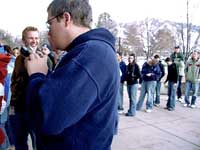
Students standing in line at the Spectrum before a basketball game. (Jessica Alexander)
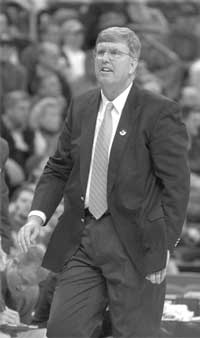
USU coach Stew Morrill. (Courtesy of Athletic Media Relations)