
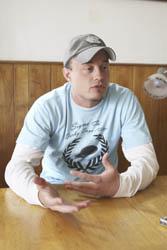
USU Iraq vet talks about war
Coming home on two weeks leave and walking off the plane into a tunnel at the Dallas Airport was amazing, Jordan Taylor said, because the airport was filled with people he didn’t know, who had come just to say thank you for the service that he and others had done in Iraq.
Taylor joined the Army Reserves in 2000 when he was seventeen; his dad signed a waiver allowing him to do that. Taylor said his father feels like it was one of the worst decisions he had made as it was all on his shoulders, and regrets signing them, while at the same time is extremely proud of his son.
Taylor signed an eight-year commitment with the Army Reserve and moved up his two year inactive ready reserve period and served an LDS mission in Canada during that time. When he got back and was in the ROTC on campus his unit was called to Iraq and he choose to go with them. He served 15 months in Iraq and one year in the US.
Taylor is also a member of the Sigma Chi fraternity house where he joined in the fall of 2004 and has been elected as president for next year. He is a sophomore and would like to own his own business one day.
During the time in Iraq he qualified for three purple hearts at different times which he received in country for his service as he did his job as a combat engineer.
Taylor said, “In Iraq, our job, my whole platoon’s, was to clear roadside bombs, the IUDs that provide the explosive devices. So each day we would go out and hunt for them. Either we found them or they found us.”
Taylor has been in nine IUD blasts, which are when the bombs exploded on their vehicles.
“After my ninth hit I wasn’t allowed to go out anymore, so I worked in the office my last four months doing logistics. There was one other guy that was hit eight times before he was sent home.”
Going five miles an hour down a road, Taylor recalled the different vehicles used and all the small signs he and others had to look for to find the bombs.
“The things are so subtle, it could be a crack in the road that the bomb is hid in, and just that crack alone makes you stop and you have to look and find all the different signs, like a patch of dirt that’s a different color than the rest of the dirt, so that means it’s fresh dirt. That’s the ways that you are trained.”
Taylor explained that is why he was hit so many times, as finding all the different hints of the bombs were so small and at times hard to notice. A lot of men went home, Taylor said, and it got to the point where he was the only man who was there the whole time. He said it was hard for his sergeant to move him because there were many new men who wouldn’t notice a crack in the road or the potholes that were signs of bombs.
Taylor said the hardest part about it was the equipment and jobs were so new that they had never seen their equipment until they got there; they had only seen pictures.
But Taylor said, “It’s not a question if there’s weapons of mass destruction because we found them. I found bombs covered in mustard gas and that’s a weapon of mass destruction. It’s not a nuclear bomb; it’s a weapon of mass destruction.”
Taylor said there are chemical weapons that Saddam Hussein and others have had and used. What bothers Taylor is that nobody cares about the war right now. He said people act like there’s not a war at all. Another issue for him are the protesters at soldiers’ funerals and not showing them or the families respect.
Taylor doesn’t think the United States will ever be out of Iraq, pointing out we are still in Japan, Germany and South Korea. He said he feels that Iraq is too strong of a foothold for the army to have in the Middle East, and that it would be a mistake to leave it.
When asked what he would do Taylor said, “If I was in charge, the stupidest thing we could do is to just leave, because look at what happened with the last time we did that.” Taylor also said that “not a lot of people agree with the war, but what’s going on over there is amazing.”
Taylor said the people finally realized even though they hated the Americans, they would help them get rid of those placing the bombs in their homes and then the Americans could leave. By the time Taylor left Ramadi, there weren’t any more bombs being placed there because the people who lived there wouldn’t allow it anymore and Taylor feels that is what it will take in all of Iraq. While in Iraq, Taylor and his platoon of 25 men found more than 300 bombs.
The hardest part for Taylor about first being home was how the sound of a door being slammed or a Coke can being opened would make him jump. The sight of a crack in the road and potholes also scared him when he first got back. Just learning to deal with it can be difficult, he said, and some people can handle it and others can’t.
“This was something I was supposed to do, not just for me… I didn’t go over there to kill or shoot people. I went over there to do my job and help people. By the time we left we had changed two cities completely around.”
-jess.allen@aggiemail.usu.edu