
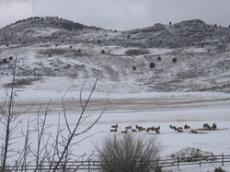
Valley elk heading for the hills early because of warm winter
Spurred by the departure of most of the elk and the muddy conditions in the area, Hardware Ranch officially closed for the season on Feb. 8, the earliest in 20 years. After a mild winter in Cache Valley, a wildlife management area near Hyrum that feeds several herds of elk through the winter has announced it is closing early this year.
Marnie Lee, the assistant manager of Hardware Ranch, which is run by the State of Utah Division of Wildlife Resources, said the hardest part of the season for her was to see them go, but she really wasn’t surprised by the departure of the elk.
“If the snow’s gone, they really have no reason to stay,” Lee said. “Their instinct is to go up higher and forage and be wild animals.”
The elk, which normally stay at Hardware Ranch until mid-March, first headed to the hills this year on Feb. 5, more than a month early. The warmer temperatures and lack of significant snow mean the elk are able to find enough forage on their own to snub the free lunch offered to them in Blacksmith Fork Canyon.
Michael Wolfe, professor of wildlife ecology and management, said he is also not surprised the elk chose to leave the area.
“It’s almost a no-brainer,” Wolfe said. “If there’s not sufficient snow to cover the forage that they eat and they can move around, that’s why they’re out of there.”
Wolfe said barring a “horrendous snowstorm,” he wouldn’t expect the elk to return to Hardware Ranch this season.
Lee agreed and said though the elk will continue to come and go sporadically to the main meadow, the majority of the approximately 400 elk that came to feed at the site this year will probably stay gone until next September when temperatures start to fall again. Only about 50 cows and calves could still be seen in the meadow last week.
Despite the elk anomaly, according to statistics provided by the Utah Climate Center, this winter in Cache Valley hasn’t necessarily been warmer on average. November, December and February thus far were all warmer than average, with temperatures up by 2, 2 and 5 degrees respectively, but October’s temperatures were 2.6 degrees lower than average, and January was 4 degrees lower than average.
Of more significance to the elk’s departure, perhaps, is the recent lack of precipitation. According to the UCC, in December Logan received only 38 percent of its normal precipitation, in January only 22 percent of normal.
Hardware Ranch was originally opened in winter of 1945 as a means to stop the elk in their natural migratory path and discourage them from going into the lower valley, where humans had encroached upon their natural winter feeding ground. Lee said a feeding program like the one at Hardware Ranch is unusual, but it became necessary to avoid the conflicts that came with large herds of Rocky Mountain Elk migrating through Cache Valley.
“If you can imagine a hay barn with an elk in there, they do a lot of damage,” Lee said. She said the reality of modern wildlife management forces them to balance the interests of nature and mankind.
“By stopping them here with feed, they’re fat, happy elk.” Lee said. “As the population of the world grows, you know, people need a place to live, too. We’re slowly taking away the wildlife habitat.”
She said even though she was sad to see them go, their departure is a good sign the elk are not becoming habituated and relying on people for their food.
Dan Christensen, the superintendent of Hardware Ranch, said the elk get fed grass and alfalfa hay, which offers them more nutrition. But even alfalfa couldn’t tempt the elk from the available sagebrush and other shrubbery exposed by the lack of snow.
“Elk like alfalfa like women like chocolate. It’s their favorite food. And even when we were giving them alfalfa, they would still be up on the hill (foraging),” Christensen said.
Christensen said the availability of natural food sources probably wasn’t the only factor for the early elk exodus this year. He said the elk’s coats, made of an outer layer of hollow, waterproof hair and an undercoat of warm down, probably made the elk uncomfortable in the rising temperatures.
“They can withstand sub-zero temperatures. Basically, when it gets to be 50 degrees, it’s just too hot for them,” Christensen said.
Christensen said the elk leaving wasn’t the only reason to close the ranch for the season. He said normally one of the biggest draws for the public is the sleigh rides through the front meadow of the 14,000-acre management area, and the conditions in the meadow were becoming too muddy for the horses to pull the wagons or for the staff to be safe.
“It was a safety decision based on we can’t operate safely up to our knees in mud,” Christensen said.
Christensen said there hasn’t been enough snow at Hardware Ranch to put runners on the sleighs in two years, and they’ve instead been using wheeled wagons. With the muddy conditions, it just became too hard for the horses.
He emphasized that the area is still open for public use year round. All areas except the front meadow are open for hunting in season, camping, fishing and other outdoor activities.
“We love seeing people up here,” Christensen said. “People think, ‘Well, you’re a wildlife management area. We can’t hunt and fish.’ And that’s not true. If they’re paying the bills, they can use it.”
He said people who still want to take a drive to try to see the straggling elk are welcome to take a look, but none of the visitors’ center services or sleigh rides will be available.
“There’s not a ‘No Trespassing’ sign on Hardware Ranch anywhere,” Christensen said.