
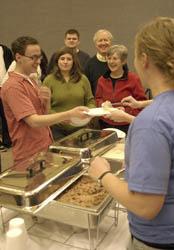
Hunger Banquet held to raise awareness of world poverty
With more than half the people squatting on the floor and squeezing rice between their fingers to quickly stick in their mouths, the Hunger Banquet left some hungrier than others.
The banquet was sponsored by the club Students Together Ending Poverty with Oxfam America. The focus for the evening was to raise money to bring technology to Nepal.
Those seated on the floor were representative of the 60 percent of the world living in poverty, said Carolyn Arambula, the co-director of STEP.
Ben Szilagyi, an event organizer, was a lower-class citizen for the event.
“I could go home and eat as much as I wanted, but it’s just to give us an idea of what it is really like. It makes a good visual,” he said.
At the beginning of the banquet, it was randomly decided who was made to be upper, middle and lower class. The rules were strict no speaking with anyone outside your class or sharing food.
The largest, lower-class group was seated on nubbly-cream and blue carpet.
“They get rice and water,” Arumbula said.
As opposed to eating with their fingers, the middle class ate with plastic utensils also was allowed to eat beans. This class was provided with plastic chairs and a long table for their stay.
But the upper class had the real banquet.
“The upper class is the group who gets a three course, nutritious meal,” Arambula said. The nutritious meal was served with real plates and glass goblets.
Chicken, vegetables, lemonade and even a chocolate brownie with raspberry sauce made up the upper class meal.
It would appear that some people got a better deal. But the lower class did not seem so upset, Coy Whitter, a public relations major said. “It’s fun, but I am glad that I don’t have to do this my whole life.”
The classes were not allowed to mix, and one member of the upper class, music teacher Megan Chadwick, said, “I felt like, ‘Look how lucky I am.'”
Though it may not be typical for college students to be considered wealthy, student Eric Wooley said, “I like how she put it, how we as upper middle class, college students, are rich compared to the rest of the world.”
The meal was short for some, and when it ended the two featured speakers, Tiffany and Mitch Spence, spoke about their volunteer work in Nepal and India and their recent honeymoon to organize groups to bring technology to rural villages.
“Literacy is the illumination for these women in Nepal,” Tiffany Spence said.
The idea was to begin bringing computers into small villages in Nepal, allowing for more information, improved literacy and an extended market.
-skjohnson@cc.usu.edu