
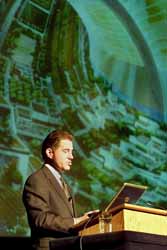
NASA official bugs students into exploring the universe
He came to infect Utah State University students with a virus, a bug he’s had nearly 50 years.
The symptoms are like those found in pioneer-spirited individuals, and can be seen in the pilgrims, American Revolutionists and Utah pioneers – anyone with an appetite for forging a new frontier. They include a severe case of ever-growing enthusiasm, along with a future-filled and wide-open mind, especially in the area of developing space cities.
He says it’s contagious. He says it’s worth catching.
“The universe is beckoning. Can you hear it?” James Logan, asked the sprinkling of a crowd gathered Wednesday afternoon in the Taggart Student Center Ballroom.
“I do not think it’s unreasonable to predict some of your grandchildren will live to see cities in space,” Logan said. “Some of your great-grandchildren and their children will be born in the cities.”
As NASA’s Chief of Medical Informatics and Health Care Systems for Space Medicine Division, Logan is in charge of creating and maintaining health safety aboard spacecraft.
But he didn’t come to represent NASA.
Logan came as a futurist individual, part of Associated Students of Utah State University’s Arts and Lectures Series. His presentation proposed a “probable and possible future” look at our solar system’s viable and untapped resources, and urged students to “get infected” with the prospects of space colonization.
“My hope today is to basically take you on a journey,” said Logan, who got infected with the frontier bug at age 7 when the former Soviet Union’s first Sputnik launched. “This journey may be both exhilarating, but also unsettling; appealing, yet at the same time appalling.”
Logan said his goal was to get audience members to forever look at the night sky differently.
“The only thing that lasts is ideas,” Logan said.
The solar system, far from simply empty space, is filled with enough resources and would generate income to generously support civilization for several generations to come, Logan said. In just one asteroid – a large, floating chunk of rock, not bothering anyone, but without value – is 3 percent metals, such as gold, aluminum, platinum, zinc, iron/nickel and cobalt, he said.
The value of metals in this non-valued rock chunk? More than $20 trillion, Logan said. And that doesn’t include several billion gallons of water also available from the asteroid.
“Forget Bill Gates, forget Microsoft,” Logan said, noting it doesn’t take rocket science to recognize where the profitable place to put our ideas, efforts and imaginations is.
Logan showed color animations of a 1,000-capacity space city shaped like a wheel and a 3 million-capacity spherical one. Each city would be completely enclosed, climate-controlled, built from non-terrestrial, or not from Earth materials, grow enough food and have enough water to support itself and would spin to create its own gravity.
And the view wouldn’t be all that bad, either.
Though potential dangers may be associated with such ideas, there are many positive possibilities, too, Logan said, and we should question all sides.
Logan encouraged students to look at the Space Studies Institute at Princeton University, www.ssi.org, for more information, and to keep feeding the fever of space development.
“Every journey begins with a single step,” Logan said, but the key is to begin.
He said he travels and speaks and attempts to infect audience members the way he does because he hopes to ignite a spark of interest among private industry, which will work itself into a “space-run” firestorm.
Logan encourages students to think and further space development because he knows more brains and energy will come from private industry than the government. Maybe the government could encourage private companies toward space cities with charter-type programs, such as the Hudson Bay Company, Logan said, but the main motivation will come from the private sector.
“I’ve exposed you to a bunch of ideas,” Logan said. “Think of those ideas kind of like viruses. I was exposed to them in 1974. Today, I’ve exposed all of you.”
History has been shown to repeat itself, Logan said, and if that’s true, mankind is due for another frontier-conquering. And Logan has already spotted one on the horizon.
“Right now, there is no frontier on Earth,” Logan said. “Our adventure is just beginning.”
-hilj@cc.usu.edu