
Just a day’s work
Friday, 6 p.m.: Officer Rob Italasano is halfway done with his shift. The next four hours will probably be more “eventful” than the previous four.
“I spend a lot of my time on Main Street,” he said. “There’s a lot of traffic there, and I stay busy there.”
Italasano has been an officer at the Logan City Police Department for nine years now. On this particular Friday night, he is the officer in charge (OIC). That means, whenever any of the other officers in the four patrol cars need anything during the night, they’ll call him.
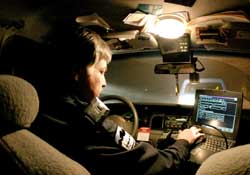
About 6:30 p.m.:Italasano observes a vehicle illegally cross a double yellow line. He flips around, turns on his lights and the truck pulls into a parking lot. After explaining to the driver what he did wrong, Italasano checks the driver’s license on his laptop. What shows up isn’t good news for the driver: He hasn’t paid a re-instatement fee for his driver’s license after getting it suspended, so it’s not valid. Italasano tells him he won’t impound the vehicle if someone with a valid license is called to drive it away. The driver agrees to the deal.
“I could write tickets until my arm fell off,” he says. “But, there’s the letter of the law and the spirit of the law. I just try to pay attention to safety and be consistent.”
Italasano said he tested with the Salt Lake City Police Department when he was 22 and was offered a job. But, his dad wanted him in the pharmaceutical business with him, so Italasano turned down the offer. The pharmaceutical company ended up going out of business. For a couple of years, he went from job to job, never finding anything permanent. His brother, John Italasano, an officer in the North Park Police Department, told him to try law enforcement again.
“I thought I was too old,” he said. “[John] said I wasn’t.”
Italasano tested with Logan, Layton and Bountiful’s police agencies. Logan accepted him first.
By then, Italasano had an associates degree in accounting, a bachelor’s in business and has attended the University of Utah, Salt Lake Community College and the University of Phoenix.
“More and more police agencies want police with degrees,” he said.
He thinks it’s a pretty good job.
“It’s stable,” he said. “You’re not going to lose your job unless you screw up pretty bad.”
About 7 p.m.: Another expired registration. The driver had already received a ticket 10 days before but said he didn’t have money to register his car until then. Italasano let him off, but told him not to drive until he had a valid registration.
Twenty minutes later: A radio dispatcher says there is a woman in west Logan complaining about people parking illegally in front of her house. Italasano makes his way to the address that appears on his laptop.
Another officer’s voice comes over the radio telling Italasano that the woman is angry – really angry.
“I’m not into parking tickets,” he said.
LCPD contracts another company to take care of parking citations, he said.
Sure enough, there are “no parking” signs up and down the road – and cars parked bumper to bumper in front of them.
Italasano pulls up next to one of the cars.
Searching for parking tickets, he mumbles, “I don’t use these very often.”
Another patrol car pulls up. The officer driving, Dustin Elleman, is the one who said the woman was angry. A reserve officer sits in the front seat. Officer Tino, Logan’s K-9, lounges in the back. The three humans discuss the situation. None know exactly why the signs are posted or why the woman is so angry. But, the signs are there, so tickets are written.
Word obviously starts circulating inside the nearby restaurant that two police cars are out. Maybe guilt, maybe fear or maybe a bunch are done eating at exactly the same time, but hoards of people are running out to move their cars.
“See the effect we have on people,” Italasano says.
By the time three tickets are written, the rest of the cars have left.
Tino, “the dog,” rides with Elleman, Italasano said. About a year ago, Elleman found out about a contest in which the winning entry would win a dog for their police agency. Of about 50 agencies’ entries, Elleman’s 500-word essay won. Tino came to Logan.
A quarter to 8 p.m.: A car drives by with its lights out. Italasano’s overhead lights go on. The driver said he didn’t notice. Not a good answer. But, Italasano asks him when his last ticket was and when the driver says more than two years ago, Italasano says he’ll be right back with a ticket and information about how to get out of it.
Three times a month, for two hours each time, Italasano teaches a driver’s awareness class at the police station. For those who have received minor tickets (no DUI’s, excessive speeding, speeding through a school zone, etc.), the class and its $55 fee dismisses the ticket and the insurance company never sees anything.
“It’s a pretty good class,” he said.
The $55 is actually a deal, he said, because most tickets are at least $50 and if the insurance company sees it, rates almost always go up.
Throughout the night, Italasano tells drivers who have a “good attitude” about the class. Those who don’t might never find out.
Fifteen minutes later: Elleman calls Italasano as backup. Tino is searching a vehicle when Italasano arrives. The driver’s license shows a history of open containers and marijuana. His hat has a marijuana leaf on it.
“We call those clues,” Italasano said.
No drugs are found, but since the license isn’t valid and there is no proof of insurance, the vehicle is impounded.
About 8:30 p.m.: A car whizzes by Italasano’s, honking. Wondering why, Italasano follows and pulls it over at the first wrong move. The driver’s information shows a repeated history of narcotics and marijuana possession. Tino comes to search the vehicle, finds nothing, and the driver is let off. He says he was honking at another driver, not Italasano. Elleman and Tino drive away.
Of all the officers, Italasano said he gives the most tickets – 1,100 last year alone.
“I’m known as a little gruff,” he said.
He added that even a lot of the reserve officers don’t like riding with him.
But the reason he gives so many tickets, he said, is because he doesn’t like to “sit around at the station.”
“I like to stay busy,” he said again.
Of all the calls Italasano received, domestic violence are the worst, he said.
“It’s about the scariest thing you’ve seen,” he said. “You get there and the husband and wife are beating the hell out of each other. When you go to arrest one of them, the other turns on you. It’s the damndest thing.”
About 9 p.m.: Italasano pulls over the third person of the night for turning left on a double yellow line. And, for the third time, he draws a diagram so the driver knows exactly what he did wrong.
Thirty minutes later: With only 30 minutes left on his shift, Italasano attempts to arrest a man for not paying tickets. The man has a statewide arrest warrant out for not paying traffic tickets, accident tickets, failure to appear (FTA) and not having a valid license or insurance. The man can’t be found though. Italasano’s been searching for him for a few days.
“He’s a personal project,” he said. “I gave him the tickets and he hasn’t paid them. I take that personally.”
Ten p.m.: End of shift.
Although Italasano said he’d like to be closer to his mom in Bountiful, he enjoys his job.
“There are so many plusses,” he said. “I’m not in an office. I get to drive where I want.”
And, he said, he likes the people.
“That last guy I stopped,” he said. “He was a pretty nice guy.
“I know it sounds corny, but I like to think I’m making a
difference.”
-emilieholmes@cc.usu.edu
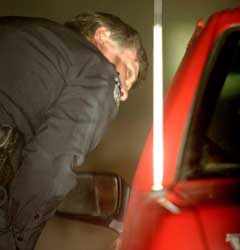
Officer Rob Italasano speaks with the driver of a vehicle he pulled over for failing to yeild to an emergency vehicle. Italasano has been working for the Logan City Police Department for nine years. (oto by John Zsiray)