
Filling a blank slate
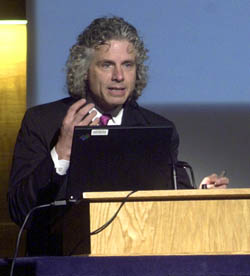
Monday afternoon ASUSU’s Arts and Lecture Series hosted Harvard psychology professor and bestselling author Steven Pinker. Pinker spoke to students and faculty in the TSC Ballroom on the human mind and different theories of human nature that are explored in his latest book “The Blank Slate.”
‘The Blank Slate’ is a book about human nature – a topic of perennial fascination – because all of us have a theory of human nature, all of us have to anticipate how people will react to their surroundings. That means that all of us need theories, explicit or implicit about what makes people tick,” Pinker said. “So much depends on our theory of human nature in our private lives. We use it to win friends and influence people, manage our relationships, bring up children and control our behavior.”
In his lecture, Pinker talked about three different doctrines that intellectuals have used to deny the existence of human nature. The first one being the “Blank Slate,” which is a theory that the mind has no innate traits. This means people are born with no instincts and must acquire knowledge from their surroundings and community.
The second doctrine, a theory called the “Noble Savage,” is based on the idea that people are born good and later corrupted by society. The third doctrine, called “The Ghost in the Machine,” focuses on the concept that everyone has a soul separate from their body.
Each of these doctrines has been heavily debated throughout history. During his lecture, Pinker explained each doctrine in depth and told the audience that grounding values in a blank slate is a mistake because it makes them hostages to fortune.
Toshikazu Kuroda, a senior majoring in psychology, came to the lecture because he is interested in psychopathology.
“I want to know how people develop,” said Kuroda.
Pinker has done extensive studies on human development, especially in children.
He talked about how genetics may have more of an effect on how children develop than the parenting methods used.
He cited examples of identical twins who were separated at birth and later met as adults to find they had similar interests and habits, such as wearing similar clothing and unique eating habits.
When his lecture was finished, Pinker then took time to any answer questions those in attendance had for him.
-nnaylor@cc.usu.edu