
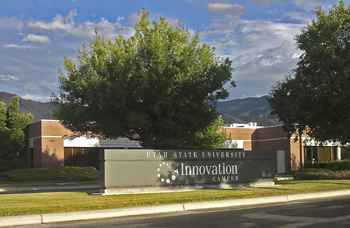
USU innovation campus expands
Utah State University’s College of Agriculture is expecting big changes in the next two or three years due to the expansion of Innovation Campus, the university’s on-campus research park.
Innovation campus is located next door to the College of Agriculture’s experiment station on 1400 North in Logan. The station will be moved to make way for further development of the research park.
The park currently covers 38 acres and is projected to cover approximately 150 acres when it is completed, Theresa McKnight, Innovation Campus manager, said.
Moving the experiment station will allow the university to open the property to build more buildings, she
said.
Paul Rasmussen, interim dean of the College of Agriculture and director of the experiment station, said the move gave USU an opportunity to create a state-of-the-art complex.
Innovation Campus contains nearly 50 private companies, USU departments and government offices. In order to build a facilities on Innovation Campus, companies must be research, technology or development- oriented or provide support service to the other companies on campus, such as Web or technical
support or food services, McKnight said.
“Innovation Campus companies have expertise in areas such as software and hardware development, aerospace engineering, market research, bio-science, pharmaceutical, research and evaluation and programs for persons with disabilities,” McKnight said. “The Innovation Campus seeks to attract anchor tenants, companies that have a large employee base and companies that are national and international leaders in the large arena of research and development efforts.”
The research park was awarded the National Award for Excellence in Rural Economic Development in May 2004 and was granted $2.5 million by the federal Department of Commerce and Economic Development in January 2005.
USU used the money from the Department of Commerce to build Grand Avenue, which opened this summer. It’s a gateway connecting Innovation Campus to North Farm, which was once the agricultural program’s experiment station and now has a 40-year development plan to expand Innovation Campus.
The immediate plans for Innovation Campus are to finish Grand Avenue and build other roadways, as well as install the necessary infrastructure south of Grand Avenue to prepare for the expansion, McKnight said.
Formerly called the Research and Technology Park, Innovation Campus was originally envisioned
as a 30- to 38-acre park to house spin-off companies from USU’s research and to expand the activities of USU’s aerospace engineering, agriculture research and biotechnology programs, McKnight said.
To ease the move from the North Farm for the agriculture department, USU asked for a $9.56 million dollar grant from the State Legislature. USU received $5 million last year and is hoping the remaining $4.56 million will come through this year.
The new location for the experiment station is south of campus, at South Farm and the Caine Dairy on Highway 89-91. The new experiment station will be called the Utah State Agricultural Complex. The buildings will be relocated over two to three years. USU will raise the old buildings as land is leased to companies joining Innovation Campus as part of the 40-year plan.
Donald Snyder, associate dean of the College of Agriculture, said the move is beneficial to the college.
“It will bring the units together. They’ll be more efficient: The feeding, the data collection and the veterinarians will all be more efficient,” he said.
Snyder said the department has built a new livestock teaching pavilion on the South Farm. They are already investing in the
South Farm, knowing they’ll lose the North Farm. Many of the 77 North Farm buildings are over 30 years old. The new complex will have new buildings and facilities.
Rasmussen said he also expects the changes will improve the department.
“It’s nice to be state of the art,” he said.
Among the facilities scheduled to move are classrooms, research and animal facilities, including equine, swine, small ruminants – rabbits, mice, etc. – and poultry.
Waste management facilities, a feed mill, a surgery and physiology lab, offices and a veterinary clinic are also scheduled to move.
Work at the current experiment station includes cattle reproduction and genetics research and diseases in sheep.
Rasmussen said the move should be seamless in most cases. Moving livestock and equipment will not be as much of a problem as relocating the crop research projects.
The largest problem is transporting students to the new complex. Fifty to 70 graduate and undergraduate students work on projects at the experiment station over the course of a year, Rasmussen said.
The agriculture department is working with USU administration to arrange for a shuttle to run between campus and the Agricultural Complex.
?ella@cc.usu.edu
-jenbeasley@cc.usu.edu