
Building for the Future
With 82 percent of on-campus housing being utilized, officials say the construction of the new $40 million Living/Learning Community is a move that is looking toward the future and not just the current state of housing at USU.
In a recent meeting with the Board of Regents, President Stan Albrecht said he plans to have Utah State University’s enrollment problems fixed within 18 months. Steven Jenson, director of Housing and Dining Services since 1995, said he anticipates growth of the university and feels it is important to have additional housing.
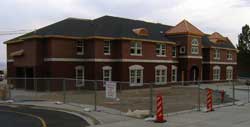
Utah State University’s new $40 million student housing project, which is supposed to be completed by fall 2006, is designed to be the “ultimate living experience,” Jenson said.
The project consists of six housing buildings, a parking terrace and a new dining facility, he said. The new housing buildings are currently called the Living and Learning Community, Jenson said, describing their location as “right in the heart of everything.” They are located next to the LDS Institute and the Taggart Student Center.
John DeVilbiss, executive director of public relations and marketing, said, “These buildings are a reflection of our institution striving to stay competitive.” He said the new buildings at the University of Utah that were built for Olympic housing are beautiful and students gravitate to them. Therefore, he said, “If we want to attract students to our institution and housing on campus, we better be building what they want to live in.”
Jenson said, “[The new buildings] should be the nicest housing anywhere in the valley and probably in the state of Utah.”
DeVilbiss said the university is instituting a big push to attract more students. To do this, he said the university is putting more focus on communicating its strengths more convincingly. These include a caring and personable staff, a safe location and research opportunities, he said.
Once these strengths have been identified, DeVilbiss said the university needs to get the word out. To do this, USU has been doing road scholars tours where the president and faculty from the university visit high schools and tell students about USU’s qualities. Thursday, they visited Preston, Idaho, he said, and more than 2,000 students along the Wasatch Front have been visited as well. The number of applications USU has received is up from last year at this time, DeVilbiss said.
With the growth of the university comes the growth of housing options. Jenson said the housing currently available is not what some students wanted and the floor plan for the new facility is different from other campus housing units. It will be suite style, Jenson said, and each suite houses eight people and has two full bathrooms with two sinks outside each, in order to maximize the number of people that can get ready at one time.
In order to pay back the university’s $40 million in government bonds over the next 30 years, Jenson said USU is relying on money from rent and parking fees. The new buildings will be capable of housing 512 students, he said.
According to USU’s Housing and Diving Services Proposed Rate Information brochure, the cost for a shared room in the new Living and Learning Community will be $2,465 per semester and $2,690 per semester for a single room. Jenson said the new living area will have 75 percent shared rooms and 25 percent single rooms. This rate includes all utilities and 10 meals per week for use in the Junction and the new Marketplace Eatery, according to the brochure. Jenson said students can upgrade the plan for an additional $275 to an open-door plan, which would give students the opportunity to eat as many times as they would like.
While this new housing is more expensive than the existing campus housing, USU is not trying to price any student out, DeVilbiss said. “We hope it’s not out of the range for most of our students.” This new housing should also open housing in other areas on campus, he said, which may be more affordable.
Students will have a new meal option next year with the addition of the new Marketplace Eatery, which will be located in the second floor of the Taggart Student Center, Jenson said. This summer, Carousel Square will be remodeled to become the new dining area and students can view the menu for both dining areas on the Internet to decide where to eat, he said.
Assistant Director of Housing Services Andy Hofmeister said there are several new features included in this area that are not available in other campus housing facilities. There are more outlets in the rooms here, he said, and even an empty one that can be used for something in the future. The carpet is done using carpet tiles, he said, which will make it easier and cheaper to replace stained or damaged areas. The housing facility also has heat and air conditioning that can be controlled in each room, Hofmeister said. The water valves are isolated in so maintenance can work on the affected area without having to shut off access to an entire apartment, floor or building, he said.
While the new area can boast all of these improvements, getting to this point has not been easy. The site has been difficult to work on, Jenson said, because the parking terrace is built on a ravine.
Director of Parking and Transportation Lisa Leishman said there will be 600 parking stalls in the new terrace and 300 of them will be reserved for residents, 100 for faculty and staff, 100 for commuter students and 100 stalls will be paid by the hour like the existing terrace.
The Parking and Transportation Department’s portion of the government bond is $380,000, Leishman said, and a cost-recovery analysis helped determine parking permit rates for the 2006-’07 school year. The cost for resident permits will be $100 for the year, Leishman said, and $195 for commuter students. Parking in the covered terrace will not be classified as B parking, she said. It will be separate and B parking rates will stay the same, she said. However, all parking permits will increase by 4 percent starting fall 2006, Leishman said, to help repay the government bonds that financed the construction of the new terrace.
Two of the new residence buildings will be on top of the parking terrace, across from the Community Center, which houses the main lobby and should be furnished by Feb. 7, 2006, Jenson said. It will be open for tours in mid-February, he said.
In February, Jenson said current USU students will have first priority to apply for housing at the Living and Learning Community, which will be home to both the Honors and leadership floors. Later, Jenson said the living center will be opened to incoming USU students.
-afox@cc.usu.edu