
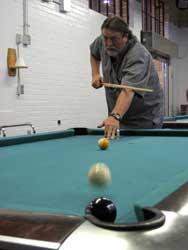
Teaching what to do when behind the eight ball
While Rick Skinner may seem quiet sitting in his chair in the Bull Pen teaching students to play pool, the things he has experienced in his life are enough to fill the pages of a very thick book.
Although the stories of his days before teaching pool to kids would fill most of this book, Skinner said he began teaching in Logan about 15 years ago to handicapped kids at the Logan Recreational Center.
“That’s how I got my job here. I interviewed for a different job and the person who interviewed me remembered me teaching the disabled children,” Skinner said.
The university had just let go of their billiards teacher, and the interviewer knew that Skinner was good with the kids he taught at the recreation center, he said.
When Skinner started teaching at USU, he said there were two classes and 20 students. This number has grown to 17 classes being taught this semester and about 300 students. This keeps him at the university almost all day five days week, Skinner said.
“I really enjoy meeting everyone, talking to people,” Skinner said. “Most students are just here to get a credit, but when some of them really get into it, really want to learn – I really enjoy that.”
As anyone who has picked up a pool cue for the first time might realize, billiards is a lot harder than it looks.
“It’s very challenging,” said Skinner, who has been teaching at USU for the last eight years. “I’ve been active in a lot of sports in my life. Pool takes a lot more practice and effort than some sports.”
This visual sport requires good hand-eye coordination, Skinner said, with precision as the key and mathematics and physics coming into play.
Skinner explained that most professionals will play anywhere from 10 to 14 hours a day, seven days a week for at least two years before they begin competing.
“After they’re pros they might only take a week off from playing in a year because it takes that much effort to stay on top,” Skinner said.
Thoughts of becoming a professional crossed Skinner’s mind, but he said he spent too much time playing in bars. After he got married, it didn’t really seem to be an option, he said.
Skinner says he had a different childhood than most, noting that his wife is writing a book about his experiences.
His father served in the military and by the time Skinner was 17 years old, he said he had moved 31 times. It was when he lived in Okinawa, Japan, his junior year in high school that he said his interest in pool grew beyond casual play at friends’ homes.
While not many people would find skydiving, flying a plane and deep-sea fishing underwater in scuba gear part of a normal childhood, Skinner said as a 9-year-old, he didn’t know any different.
From the early years of his life, Skinner had a very active life – much of what he learned from his father whom he describes as an extremist.
“[My father] and his friends would throw their parachutes out of the airplane, then jump out after them, just for a thrill,” he said.
Skinner said his father taught him to fight, and when he was 9 years old, he was on a boxing team in Juarez, Mexico.
“When I was young, I thought I was 10 feet tall and bullet-proof,” Skinner said.
About this same age, Skinner said he learned to fly a plane, scuba dive and also skydive.
“My father used to have a small plane when we lived in El Paso, Texas. He would hang out the door and shoot coyotes,” Skinner said. “How in the world he trusted me to fly an airplane at my age, I’ll never know.”
With interests in many sports, and “being way too active,” Skinner said he has sustained quite a list of injuries in his life with four different shoulder surgeries, two lower back surgeries and nine broken noses. A few of those broken noses came when he worked as a bouncer for several years, he said.
Looking back on his life, Skinner said the most important thing a person can do is make good choices.
“If I could go back knowing what I know now, I’d change a lot of things,” he said. “However, I may be a different person.”
Skinner said he will remain teaching either until retirement or until the university gets sick of him.
-ashleykarras@cc.usu.edu

(Scott Erickson)