
Music to your ears
Ever wondered what music therapy is or how it is used? Don’t worry, you’re not the only one.
According to Alyson Sheppard, the Music Therapy Student Association president, music therapy is misunderstood a lot because people don’t know what it entails. Many think that is it simply playing music or being an entertainer, she said, and that isn’t the case.
The American Music Therapy Association defines music therapy as “an established allied health profession using music and music activities to address physical, psychological, cognitive and social needs of individuals with disabilities.”
Basically, it is combining music and psychology along with behavioral science to understand how music can help people with disabilities or illnesses reach non-music goals such as improving motor skills or memory, dealing with stress or pain, through the use of music, Sheppard said.
Utah State University’s music therapy program is one of the prominent programs in the country said Maureen Hearns, the director of the music therapy program. She accredits this to the research work of Dr. Elizabeth York and Dr. Bruce Saperston.
“[They] have contributed substantial amounts of research based information to the [music therapy] program at large,” Hearns said. This has been accomplished with the research-based style of USU and the effort of these doctors.
USU’s music therapy program, which has been in place since the late 1970s, is the only one in the state of Utah and one of six programs in eight states in the western United States, and Hearns said this is what draws a lot of the students in the program.
“[Also] because of the community values of Cache Valley and our state,” Hearns said, noting USU’s music therapy program attracts students from all over the country.
Jessica Harris, a peer adviser for the program, said students majoring in music therapy must be committed to the program and have a real love for what they will do when they have completed the program.
“It’s not for the weak-hearted,” Harris said.
Both Sheppard and Harris agree that the program is intense because many of the classes required are only one or two credits since students must take a large variety of classes, but they can’t be required to take more than the 120 graduation credits.
Added on to regular class work, imagine learning to be proficient in guitar, piano and voice and learning percussion and recorder techniques. That’s what music therapy students do along with any other instruments they want or already know.
Combining these musical skills with their knowledge of psychology and behavioral science, these students learn how to help people deal with issues in a unique way, participants said.
“I love how people respond to [music] no matter what their problems are,” said Samantha Kesler, a freshmen in music therapy.
This love of seeing how people respond to music, along with the support of fellow students is what convinced Harris to stick with the program.
“There is something beautiful and magical about music. Music is a medium that reaches people in ways that nothing else can,” Harris said.
The music therapy program takes four years for new students to complete, and two to three for transfer or students who already have a degree. Amidst other classes, students complete four practicum each at a different site so they deal with people of different ages and different disabilities.
Logan Regional Hospital, Sunshine Terrace, Youth Track, Bear River Mental Health, the CAPSA program, elementary schools and Avalon Hills, which deals with eating disorders, are just a few of the places students can do their practicum during their junior and senior year.
Following a six-month internship, students take a board certification exam, and upon passing it, are considered Music Therapy Board Certified.
Music therapy is something that many people don’t fully understand, but the program is trying to change that.
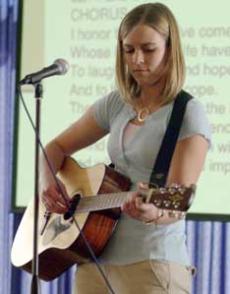
Four students presented their findings from their practicum in the second yearly music therapy forum held on Thursday. The program hopes to continue increasing understanding about the benefits of music therapy and the overall view people have of it.
For more information about the program, visit the Web site at www.usu.edu/music, then go to the music therapy link.
-albaugh@cc.usu.edu