
A hunter’s heaven
Hunting is an adventure. At least that is how Joseph Brough feels about the sport.
“It can take you places you have never been to before,” he said.
Brough, from Wellsville, is not the typical camouflaged hunter. He has spent many hunting excursions all over the globe in exotic places such as Mongolia, Russia, above the Arctic Circle and Africa.
Brough said he enjoys hunting game of all sorts, but if he had to make a choice, he said it would be a toss up between animals that are dangerous and mountain sheep.
“I have shot what I believe are grand slams,” Brough said. “There are four species of mountain sheep in North America, and I have been able to collect all four. I love mountain sheep because they are some of the prettiest animals. But I also love to hunt the dangerous game because of its extreme intensity.”
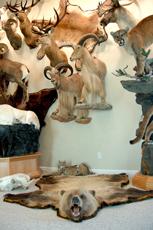
Brough has shot a wide assortment of animals, including lions, leopards, buffalo and bears. In his home, he has somewhere between 80 and 100 mounted animals that he’s shot.
“I have a large room in my home where I keep all my taxidermies. I believe that this gives people the opportunity to see things they wouldn’t see anywhere else,” Brough said.
Brough is among many hunters who enjoy spending time in the great outdoors. According to Fish and Wildlife Service’s Web site, their most recent national survey showed that more than 13 million hunters ages 16 and up enjoy hunting in the United States. Between the 13 million hunters, 228 days were spent hunting, 200 million hunting trips were taken and $20.6 billion was spent pursuing their passion, according to the survey.
Brough’s love of hunting started as a family tradition, he said. It began with his father’s family, who hunted not only for enjoyment, but because it was a necessity.
“My father’s family needed the meat they shot for food,” Brough said. “If they were not successful, they didn’t have food. It was that simple.”
Brough and his family eat most of the meat that they shoot. He said their favorite wild meat to eat is elk.
If we won’t eat (the meat), I wrap it up and equally distribute it with my coworkers at work,” he said.
Hunting has now not only become a sport for entertainment or a necessity for food; it has now become an important tool for wildlife management.
Fish and Wildlife Service recognizes that in many cases, hunting controls populations of some species that might otherwise threaten the well-being of other wildlife, and in some instances, that of human health and safety, according to the Web site.
Brough recalled a time when his safety was put on the line as he was moose hunting in British Columbia with his younger brother.
It was warm weather, and Brough’s brother shot a large bull moose, he said. Packing the meat and taking it back to camp took all day, and when they were finally finished, Brough and his brother were exhausted. Then, that evening at their campsite, they heard something nearby.
“About 30 feet away we heard a bear bark,” Brough said. “Bears don’t growl like a typical bear when they are aggressive; they bark. So we knew it was dangerous and we had to stay away.”
They spent the rest of the evening listening to the bear tear up canvas and destroy their campsite to get a hold of the recently shot meat.
“When you can hear a bear that close to you, you don’t get much sleep,” Brough said. “We spent the remainder of the night listening to it and praying that it was a black bear. We had a license at the time for black bears and hoped that is what it was. That way we could shoot it in the morning if it was still in camp.”
Around 4:30 that morning, Brough, his brother and their hunting guide Bobby looked at the situation outside, he said. It was not a black bear that had stolen their meat, but a large grizzly bear. They did not have a license to kill the grizzly bear and were puzzled at what to do, Brough said.
Their campsite was set up in a narrow canyon and the only way out was to walk directly past the bear, Brough said. Bobby borrowed a gun and created the game plan.
“Bobby was going to shoot directly over the top of the bear to scare it away,” Brough said. “However, if the bear started running towards us, my job was to shoot the bear in the head. I was always taught though to never shoot a bear in the head because it would ricochet off of the bear’s skull. So I didn’t know what to do.”
Bobby did shoot above the bear, which consequently caused the bear to turn and race toward them. In what seemed like slow motion, Brough said he waited for the bear to turn its head so he could do what he thought best: shoot the bear between the ears and hit the brain.
“I shot the bear where I wanted to, and it fell to the ground only about 25-30 feet directly in front of us,” he said. “That is when I started to get scared. I started shaking and didn’t know what to do. We then turned ourselves into the Fish and Game but were not found guilty because it was in self-defense.”
Brough said even though hunting is such a dangerous sport, he has only had two times when he has had animals come after him. One incident involved the grizzly bear and the other was with a cape buffalo when Brough was young.
Brough said hunting is now bonding time between him and his family. Both his sons and daughters enjoy the challenge of hunting, and have become avid hunters, he said.
“When I am hunting, I am with people I care about,” he said. “I go to places that are totally remote and unique. That is what makes hunting such an adventure.”
-courtnie.packer@aggiemail.usu.edu
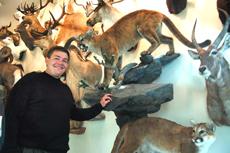
Joseph brough has been hunting around the world. He displays the animals he shoots in his home. (Noelle Berlage)