
The evolution of Homecoming
Ever since USU Homecoming’s inception 30 years ago, many things have changed, but it has always been a week-long process, according to USU archives. At the end of the week, the university would invite alumni to activities and the weekend dance for a day of celebrating the creativity and spirit of the Aggies.
The most exciting and hailed activities in the past have fluctuated over the years. In the 1940s, the main attraction for Homecoming Week was the Saturday morning parade down Main Street. It was planned for weeks, even months in advance, and people would come from all around the area to see the extravagant floats that were judged and praised.
“The Homecoming parade constitutes one of our primary attractions,” Marlin Woodland, parade chairman in 1948, stated in an archived document. What was once a full, exciting day of a parade has now been reduced to a two-hour tailgate party.
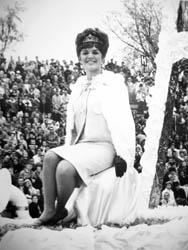
Another tradition that has been downplayed considerably over the years is the Homecoming queen. In years past, the Homecoming Queen Pageant would be held on the Monday of Homecoming Week. The winner would be involved in the rest of the activities for the week, being one of the most highlighted attractions and riding a float in the parade, according to the archives.
In the 1960s, the football games and a talent show called Rhythm Rhapsodies were the highlights of Homecoming, but one of the most anticipated moments was the Queen Pageant. It was viewed as USU’s own Miss America pageant. The pageant consisted of a bathing suit portion, evening gowns and discussions for the theme of Homecoming that year. The girls were judged for their poise, good grooming, personality and beauty, as stated in documents in the archives.
When told about the history of the Homecoming Queen Pageant, Haley Peterson, an undeclared sophomore, said, “Oh, gag! That’s so ridiculous.”
Others agreed with Peterson. Jason Chesney, a junior in public relations, said it sounded like a huge popularity contest and if it was still happening today, he would feel like he was in high school. “There’d be no meaning to it,” he said.
Jaci Porter, a senior in history education, disagreed with Chesney and Peterson. “I think every girl dreams of being a queen,” she said. “I think it would be fun.”
But one part of the present-day Homecoming Week many people don’t realize is that a Homecoming queen is still chosen every year. Peterson admitted that she had no idea, and didn’t find the title very appealing. “I’m not into the whole pink and purple princessy façade,” she said. “I’d rather study than learn how to walk in heels.”
In the early days of USU’s Homecoming, everyone, including students, alumni and faculty were involved in the preparing and initiation of the activities. Now, most people don’t consider it as much of a big deal.
“It’s the social event of the weekend,” Chesney said.
Mistie Park, a senior in physical education, volunteers for Homecoming Week. She said, “It’s hard to accommodate everyone, but that’s what they’re trying to do.”
She said most people make a big deal out of one event, but it’s really about the whole week of fun activities. “You’re bound to be interested in one of them,” she said.
Some students just don’t share Park’s enthusiasm. Chesney said he hadn’t been to many Homecoming activities. “I would definitely go to Homecoming if we had a better football team,” Chesney said.
Park said, “People should have pride no matter what. That’s a part of Homecoming.”
Porter agreed, saying, “I love my school, and homecoming is a reflection of pride for school.”
The Homecoming dance has never been as big of a deal as some of the other activities, but just a place where people have the opportunity to dress up and go on a date. Many students have never been to it, and some simply have no desire to attend. “I think it’s a little high-schoolish,” Peterson said.
But others who have attended have more positive feelings toward the dance. Porter said when she attended, there was good music and it was just fun, but not enough students attended the formal. “Maybe more people would go if it was cheaper,” she said.
Chesney wasn’t so sure if the cost is the problem, saying, “That’s like a third of what my high school’s cost.”
As stated in the USU archives, in 1947, one ticket for the dance cost 75 cents. In 1974, it was $2 per couple. Back then, a full-course meal was provided and a guest speaker would come and share his thoughts. This year, it is $15 per couple in advance, $20 at the door and students have the opportunity to go from theme room to theme room,
Park said even though she is not attending the formal, she will participate in any way she can. “People can still help and volunteer,” she said. “There’s so many ways you can get involved in Homecoming Week. It’s ridiculous to just sit at home on your butt.”
-marylour@cc.usu.edu