
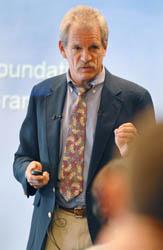
Speaker suggests students can do better than studying for tests in Superman underwear
Some students eat Alaskan salmon, while others wear Superman underwear and some watch back-to-back episodes of “ER” to prepare for tests.
“It is fun to wear Superman underwear, but I think we can do better than that,” said Mark McDaniel, psychology professor at Washington University in St. Louis, Mo.
McDaniel spoke to students and faculty yesterday in the library on basic memory principles to use for testing. McDaniel has done research in this area for many years and written books on the subject.
McDaniel said his extensive studies and experiments have been with students and their ability to retain knowledge and the way they study for classes. He said most students will re-read a chapter of their textbook in order to study. Yet his studies show that those who read the chapter twice perform about the same as students who read it once. The reason for this is they aren’t really delving into the chapters or gaining anything new, McDaniel said. When the students re-read the chapter, they feel good because they seem to already know the information, McDaniel said.
“There is a negative correlation between what they think they learned and what they actually learned,” McDaniel said of students’ tests results after studying by simply re-reading the chapter.
The best way to help students retain the knowledge in their long-term memory is for professors to give more quizzes, McDaniel said. These quizzes should include both multiple choice and short answer in order to allow students to have to answer the “why” questions, because doing this is where they really learn the information and are able to remember it better, he said.
McDaniel told faculty these quizzes should be in the same format as the tests that will be given in order to see the correlation. McDaniel did research on students who took quizzes on the information they read and learned in class and found that those who did had a grade increase of up to one whole letter. Yet these quizzes don’t need to account for a large part of the class grade, McDaniel said, as long as they are set in the same format as the test and given frequently.
“Don’t just use testing as a summative device to give students a grade. Use low or no-state quizzes to encourage learning,” McDaniel told professors.
Students can prepare for these quizzes by quizzing themselves, McDaniel said. And if professors don’t give quizzes, quiz yourself, he told students. Covering half their notes and seeing what they can recall, or being part of a productive study group and taking turns teaching are other ways McDaniel encouraged students to get the most out of their studying.
A lot of these skills are already being taught at USU, said Debi Jensen, who works in the Academic Resource Center and teaches Strategies for Academic Success. She said she has found the ideas given by McDaniel were ones students told her worked and that she has implemented.
“I tell my students to study smarter, not harder,” Jensen said.
There are many positive consequences from these quizzes, McDaniel said. These include motivating the students to keep up with the reading, which causes them to study the information more to do well on the quizzes, and they are able to retain the information longer.
In the next 10 years, McDaniel said he thinks all textbooks will be online, and he is working on doing research into having each textbook fit to the individual. This could include embedded questions, making the text explicitly clear for those of a lower reading level and having those on a higher level have to draw more conclusions from their readings, McDaniel said.
-alison.baugh@aggiemail.usu.edu