

Going cold turkey
Jescee Bennett, education specialist of the Student Wellness Center, would trade a smoker one turkey sandwich for their pack of cigarettes if they can go “cold turkey” for a day.
The event was part of the American Cancer Society’s 28th Great American Smokeout.
“November has one day set aside each year to encourage smokers to quit for that day, it’s called the Great American Smokeout,” she said. “This year we [sponsored] it on Nov. 17 and 18.”
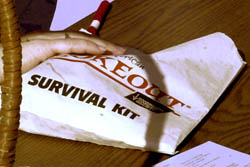
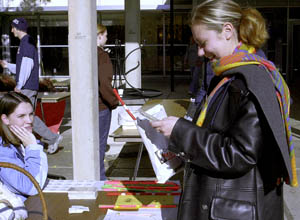
The first day is usually the hardest to quit, so the Wellness Center passed out Quit Kits at the Taggert Student Center’s Patio to help the addicted smoker quit, Bennett said.
The Quit Kits provided fidget toys like a stress ball, a bendy stick and had pamphlets in the kits to inform smokers of medication that can help them break the habit. It also was supplied with tarot cards, showing the future of smoking.
“The kits also provide gum and candy so they can keep their mouth busy as they crave the cigarette,” Bennett said.
Bennett, a graduate student studying community health, said there are more than enough reasons to quit smoking but “the No. 1 reason to quit is for health.
Jake Guttormsen, a junior studying personal finance, said he smoked for three years and knows smoking is “something you don’t want to get involved in.” It took him three times trying to quit before it finally worked.
“As I was trying to quit, I had mood swings,” Guttormsen said. “I almost knew what serious depression is – desiring [the cigarette] just sucked. It was a hell of a lot easier to quit drinking.”
Guttormsen said he hasn’t smoked regularly for about five months. He is preparing for a LDS mission and is expecting his call soon, which along with other factors, prompted the change in his lifestyle.
Guttormsen said he decided to pick up his first cigarette when he was 17 because of stress.
“I was working in the restaurant business in Texas,” Guttormsen said. “The stress was really high, so I went out with the employees and I was addicted after the first one.”
His parents eventually caught on to his habit, he said. His dad is a former smoker and knew the signs. They were very supportive to help him.
With a religious upbringing, he said he was embarrassed when he would light up at Utah State University, because of the religious community. He said during his freshman year, he would hide with friends as they puffed away. He became a “closet smoker.”
The cancer society’s Web site states 87 percent of lung cancer deaths are because of smoking and 30 percent of cancer deaths are because of the habit. The site also said that after 24 hours of quitting, chances of a heart attack noticeably decreases. In the United States alone, close to 440,000 people will die from smoking-related illness this year and 160,000 of them will be from cancer.
According to the cancer society, a national survey after the 2003 Smokeout found more than 8.3 million of the estimated 46.2 million smokers nationwide (18 percent) took part in the annual event, with nearly 2.3 million (five percent) giving up completely for the day. If the same number took part this year, more than 32,000 smokers along the Wasatch Front were expected to smoke less or not at all during the Great American Smokeout.
“While the number of people who smoke in Utah has decreased significantly over the years, almost 500 people will be diagnosed with lung cancer this year alone,” said Rose Defa, Vice President of Operations with the American Cancer Society. “We encourage[d] anyone who has ever thought about quitting to take that first step on Nov 18.”
Defa said if they took that challenge, it would be the “best decision they’ve ever made.”
Guttormsen said the first day was the hardest but it only got easier the longer he went. He quit on his “own plan,” with support from his family and hockey coach, he believes quitting for yourself is the most important part of the process, he said.
“You can date a girl that begs you to quit,” Guttormsen said. “But after a while that becomes annoying, it’s got to be because you want to quit – that’s the first step.”
After he quit officially three months ago, Guttormsen said he feels happier knowing he was able to do one of the hardest things ever.
“Every day, I think about how I quit,” he said. “When I’m on my mission I just want to help people feel happy like how I feel. If a member or an investigator has a problem with smoking, I can help them.”
He said knowing he could conquer that habit made him realize he was in control of his life.
Bennett said the Wellness Center has a confidential program to support anyone who wants to quit smoking and they are there to help and support anyone.
The American Cancer Society also offers support and information for smokers who want to quit 24 hours a day, by calling 1-800-ACS-2345 or visiting them online at www.cancer.org.
-srkrebs@cc.usu.edu

Jake Guttorsmen talks about how he quit smoking during an interview Tuesday afternoon in the TSC Sunburst Lounge. (Photo by Michael Sharp)
(Photo by Jessica Alexander)
(Photo by Jessica Alexander)