
$8.5 million facility dedicated
The new $8.5 million Poisonous Plants Research Laboratory, located on the Utah State University campus, was dedicated Tuesday afternoon, becoming the first permanent home the laboratory has had in 40 years.
The PPRL is one of 100 research laboratories throughout the United States that is part of the United States Department of Agriculture [USDA], and is the only laboratory completely dedicated to the study of poisonous plants, said Rodney J. Brown, undersecretary of agriculture for research, education and extension.
Most of the research conducted at the PPRL will benefit agriculture.
“I want to thank Dr. [Lynn F.] James and the other professionals at the laboratory that have taken years and years of shared study that will benefit cattle producers from across the nation,” said Monte Weston, president of the Utah Cattlemen’s Association. “They have studied long and hard to help us protect our animals.”
Poisonous plants cost livestock producers $345 million annually, $3 million in birth defects alone, said Edward Knipling, an agricultural research service [ASR] administrator.
But the research being conducted at the laboratory is of value to others as well, Knipling said. For example, research on plants that cause cleft pallets in calves is of great value to researchers studying the causes of cleft palates in humans.
“Many could have used this support, so the fact [the federal government] has invested this money and support demonstrates how important what we’re doing is,” Brown said.
Paul Rasmussen, director of the Utah Agricultural Experiment Station and a USU professor, said widespread importance of the laboratory was demonstrated by the presence of American Cancer Institute representatives at the presentation.
Rasmussen said the importance of the laboratory has also increased since the Sept. 11, 2001, attacks because some of the plant research being done relates to bioterrorism.
Wilbert Blackburn, USDA-ARS Northern Plains Area director, expressed appreciation for the “wonderful relationship” the laboratory has with USU. While the building belongs to a branch of the federal government, the laboratory exists because of cooperation between the university, the state of Utah and the federal government, he said.
In the past, many students and professors have had the opportunity to participate in research at the laboratory.
“[Students] want to move the frontiers of science forward and we join hands with them in that,” Rasmussen said.
Brown said the laboratory is a prime example of applied research in our society.
“When we do research we should have a purpose in mind – we should have a goal,” he said. “We are not only an internationally recognized laboratory. We are the only laboratory of its kind in the world. It’s been leading the way for a very long time in what we’re seeing in all of research now.”
The USDA began poisonous plants studies as early as 1894, according to a pamphlet distributed at the dedication, with experimental stations located in Colorado, Montana and in Salina, Utah.
The Poisonous Plant Research Laboratory was created in 1955 in Logan. By 1964, the experimental station had grown to an 11-acre site and a metal building has served as the “temporary” office and laboratory of the PPRL for the past 40 years, said Research Leader, Lynn F. James.
“This is the laboratories first permanent home,” said James who has been the research leader since 1972. “I, myself, spent two summers living a tent.”
Utah Sen. Bob Bennett was attributed by many of the dedication speakers as the person responsible for the funding of the PPRL. Bennett was unable to be at the dedication to receive a plaque in his honor because discussion of the PPRL was taking place in Washington, D.C. Glenn Mecham accepted the award in his place.
“We would very much have liked Sen. Bennett to be here for this event, but we would much rather see him where he is leading the fight for our budget,” Brown said.
Brown said Bennett was able to appropriate around $10 million toward the construction and staffing of the laboratory.
“Bennett is a very, very good friend of agriculture in Utah,” he said.
-bnelson@cc.usu.edu
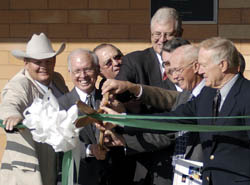
Officials from the Poisonous Plants Research Laboratory, the U.S. Department of Agriculture, the Utah Farm Bureau and the Utah Cattleman´s Association cut the ribbon to dedicate the new building Tuesday morning. (Photo by Ryan Talbot)