
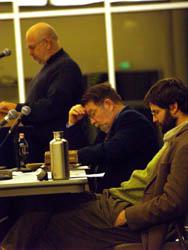
Nature of God debated by panel
Representatives of the Catholic Church, Protestant Church and The Church of Jesus Christ of Latter-day Saints offered similar and different views on questions such as, “Is God one or three separate beings?” and “Why did God create the world?” at a religious discussion Wednesday night.
Catholic philosopher Harrison Kliner, Lutheran James Wakefield, Mormon Richard Sherlock, also USU professor of religious studies, each spoke about their own religion and answered questions from the audience in the Sunburst Lounge.
Catholics believe there is only one god and God is too great for a body, Kliner said. But, Sherlock said, Mormons believe God, Jesus Christ and the Holy Spirit are three different beings, who are not necessarily corporeal, though this belief varies between different Mormons.
According to Kliner, Mormons differ from Nicene Christians in a number of ways. He said Nicene Christians believe in a multitude of gods, that all persons are eternal and that God is progressive.
The difference between Mormonism and Catholicism, Sherlock said, is Mormonism doesn’t have creeds or final theological points in its teachings. He said Mormon theology is fully consistent with the Bible, but the Bible itself can yield several theologies.
Sherlock also said there is a difference between “mainstream Mormonism” and what he believes. Mainstream Mormons differ more from Catholics and Protestants than he thinks they should, he said.
Mormon, Catholic and Protestant beliefs about why the Earth was created also differ. Kliner said Catholics believe “God is self-giving love” and this love motivates God to do all things – including creating the world.
Wakefield said the Protestant view is “God is love and whoever lives in love lives in God and God in them.” He agreed with much of what Kliner said, and said the world was not created by necessity, but by an abundance of God’s love.
Mormons believe the world was created by God for man, Sherlock said.
God gave man free agency, Sherlock said, so they can choose for themselves how the future will unfold. Sherlock said God can’t know what someone will do until they do it.
Not everyone in attendance agreed with his views.
Freshman Jenele Vander Veur said, “I disagree with much of what the Mormon theologian talked about.”
A Mormon herself, Vander Veur said she didn’t think Sherlock represented her religion very well. She said he was confusing and didn’t seem to agree with things she had been taught about her faith.
Gabrielle Isaacs, freshman, said she would have liked to see more religions represented on the panel. She said having a Buddhist, a Muslim and a Jew would have helped to give the panel more diversity and interest.
“The Lutherans and Catholics seemed to agree on a lot of things, and the Mormons were out there on their own, so having more religions could have bridged that gap a little,” Isaacs said.
-amanda.pie@aggiemail.usu.edu