
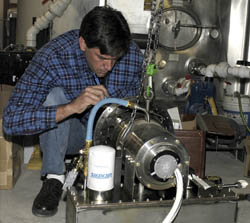
Manure study leads to pollution control
Researchers at Utah State University received a grant of $369,000 Sept. 16 to further research of cost-effective ways to reduce odor and pollution caused by manure, while turning the material into a source of energy. The grant, awarded by the U.S. Department of Agriculture, is part of more than $14 million in grants awarded to innovative approaches and technologies involving conservation projects nationwide. Led by Conly Hansen, a professor in the Nutrition and Food Sciences Department, the USU project looks to further develop ways of turning manure into energy, while at the same time reducing odor and pollution caused by the waste. “Conly has developed some new technology,” said Niels Hansen, a resource conservationist at the USDA. “He’s been able to take an unusual resource and turn it into energy.” The energy produced from the manure is actually derived from methane gas, a byproduct of the anaerobic bacteria alive in the excrement, Niels said. By simulating the environment of a cow’s stomach, Niels said Conly has been successful in keeping the bacteria alive and thriving in ways similar research has not. Still, even more important than creating energy from the manure, Carl Hansen a research scientist in the NFSC and Conly’s brother said, will be the reduction of pollution from animal waste. “The [Environmental Protection Agency] is demanding change,” Carl said. “Everyone’s scrambling to find something reliable.” Methane gasses released by the bacteria are 18 times more detrimental to the atmosphere than carbon dioxide, Carl said, something the USU facilities are designed to help remedy. “The anaerobic digester captures methane, burns it and makes it harmless,” Carl said. “These facilities will greatly reduce greenhouse gasses and air pollution.” The processed manure, which remains usable as fertilizer, would also contain lower amounts of phosphorous – a common pollutant of ground water, Carl said While anaerobic digestion research has existed since the early 1970s, Bronson Smart, an engineer for the USDA’s Natural Resource Conservation Service department, said, more than 80 percent of such projects have failed. Carl said he thought a “lack of management” was the cause of the failures. “The farmer doesn’t know what he’s getting into,” Carl said. “He’s used to livestock or dairy and doesn’t realize he has to be more involved.” Smart also credits Conly for pioneering one of the first anaerobic digestion facilities to achieve success in a cold climate. “There are a bunch in Florida and North Carolina,” Smart said. “But Utah State’s been one of three or four universities that have been able to be successful in a cold climate.” The USU design has been so effective, Smart said, because the digestor uses the heat produced by its generator to heat the bacteria tanks. Currently USU operates an anaerobic digester in Benson, but will open a second in Ogden in a month. Conly said the grant will allow for the university to open another cite in Corinne and begin plans for a fourth in Chester, a town just outside of Moroni. “[The grant] will put one more experimental digester out there for research purposes,” Carl said. “It will be a different type of facility.” Conly said the newer facilities will feature more efficient ways to reproduce anaerobic bacteria, in addition to being completely automated – something that should improve the future success of other anaerobic digesters. “There are great benefits,” Smart said, “especially to agriculture. The energy from the plant in Ogden can power 200 plus homes. There’s a significant environmental benefit. When we spread [untreated] animal waste on the ground, it’s like spreading diesel fuel on the road.” According to a press release, nationally, more than 150 project proposals from across the nation were submitted. USU is one of about 40 institutions to receive funding. “We are pleased to partner with researchers at Utah State University who are leading the way in efforts to bring technology, conservation and effective farming practices together,” NRCS State Conservationist Sylvia Gillen said.-acf@cc.usu.edu