
Cycle of Censorship
Banned, burned, censored and suppressed.
The reasons may be different.
The results are the same.
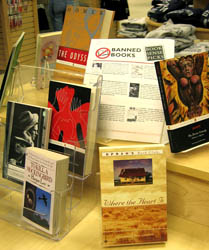
In conjunction with the nationwide American Library Association (ALA) sponsored Banned Book Week which began Monday, the Utah State University Bookstore has setup a display of books that at one time or another have been censored or banned.
“I like to make the public aware of books that have been banned in the past,” said Risa Smith, USU Bookstore’s general book buyer. “I mean, all the Harry Potter books have been banned at one time, the Bible, you can go on forever.”
The display, which includes a manual listing hundreds of books suppressed in the United States, is set up mostly to inform students.
“I think it’s more of a matter of freedom of speech and some people choose to read certain things,” Smith said. “They should be allowed to do that. I think a lot of the students are just surprised by all the books that have been banned.”
Though many of the books on the list have long since been accepted almost universally, hundreds of challenges still come in every year requesting, and sometimes demanding, that certain books be removed from reading lists, public libraries and schools.
The official ALA banned book Web site www.ala.org/bbooks makes the distinction between a challenge and a banning.
“A challenge is an attempt to remove or restrict materials, based upon the objections of a person or group. A banning is the removal of those materials.”
The Web site goes on to list the top 10 challenged books of 2003 compiled by the ALA Office for Intellectual Freedom, including the reasons for the challenge:
1. The Alice series (“Alice in Agony”, “Reluctantly Alice”, etc…), by Phyllis Reynolds Naylor’s, challenged for sexual content, using offensive language, and being unsuited to age group.
2. The Harry Potter series, by J.K. Rowling, challenged for its focus on wizardry and magic.
3. “Of Mice and Men” by John Steinbeck, challenged for using offensive language.
4. “Arming America: The Origins of a National Gun Culture” by Michael A. Bellesiles, challenged for inaccuracy.
5. “Fallen Angels” by Walter Dean Myers, challenged for racism, sexual content, offensive language, drugs and violence.
6. “Go Ask Alice” by Anonymous, challenged for its references to drugs.
7. “It’s Perfectly Normal” by Robie Harris, challenged for homosexuality, nudity, sexual content and sex education.
8. “We All Fall Down” by Robert Cormier, challenged for offensive language and sexual content.
9. “King and King” by Linda de Haan, challenged for homosexuality.
10. “Bridge to Terabithia” by Katherine Paterson, challenged for offensive language and occult/satanism.
Of the 6,364 challenges reported to or recorded by the Office for Intellectual Freedom between 1990 and 2000, 25 pecent were made for “sexually explicit” material, 22 percent for material containing “offensive language,” 13 percent for material containing an “occult theme or promoting Satanism,” and the remainder for material “promoting homosexuality, promoting a religious viewpoint” or containing “nudity, racism, sex education and anti-family sentiments.”
What follows is a sample of the books that have been banned through history. All information has been compiled from www.thefileroom.org, onlinebooks.library.upenn.edu and “Banned Books,” by Anne Lyon Haight.
Religious Texts –
The Bible (Christianity), the Talmud (Judaism), and the Quran (Islam) have all been banned in numerous countries through history for both political and religious reasons.
In the Soviet Union in 1926, the official directions given to libraries stated that “the section on religion must contain solely anti-religious books. Religiously dogmatic books such as the Gospel, the Koran, and the Talmud. may be left in the large libraries but removed from the smaller ones.”
The ban was not lifted until 1956.
In 1953, in the N.C., a page of the Revised Standard Version of the Bible was burned by a Baptist minister in protest of certain words that version used.
On July 1, 1996, the government of Singapore convicted a woman for possessing the Jehovah’s Witness version of the Bible. The religion is officially outlawed in the country. Muslim countries such as Burma and Saudi Arabia also ban the distribution of Bibles to Muslims.
In 1999, the government of China repressed and banned a religious sect known as Falun Gong and confiscated or destroyed all books by the founder of the sect. The ban remains to this day.
A Book on Censorship –
Richard Meyer’s books, “Outlaw Representation: Censorship and Homosexuality in Twentieth Century American Art” was banned for the inclusion of a supposed pornographic photograph of a young boy taken by Robert Mapplethorpe.
“The picture at issue, a portrait entitled ‘Jesse McBride’ is not pornographic or obscene in any way,” said Meyer, “and part of what I discuss in the book is how the patently false charge of child pornography has been used as a justification to suppress Mapplethorpe’s work. Using these same arguments, Oxford has, in effect, censored a scholarly book on censorship.”
American Classics –
Several dozen copies of Kurt Vonnegut’s novel, “Slaughterhouse Five”, created as a fictitious recounting of his experiences during WWII, were burned on Nov. 7, 1973 by a school custodian because members of the local school board decided it was pornographic.
“Of Mice and Men,” by John Steinbeck, widely considered to be a classic piece of American literature, has been challenged and banned numerous times for inclusion of racial slurs, profanity and violence. Most recently, in October 2003, the book was challenged in Normal, Ill.
Nobel prize winning author Ernest Hemingway has had several of his novels suppressed or challenged including, “A Farewell to Arms,” “For Whom the Bell Tolls” and “Across the River and Into the Trees.”
Other censored books-
Under the Nazi regime, all books by Jewish authors were burned, including “Bambi,” written by Felix Salten.
Copies of “The Lord of the Rings” trilogy by British author J.R.R. Tolkien were burned outside of a churchhouse in New Mexico for “Satanic” content. Other books most frequently banned in the ’90s, according to “Banned in the U.S.A.,” by Herbert N. Foerstel, include:
*”Lord of the Flies,” by William Golding
*”A Wrinkle in Time,” by Madeleine L’Engle
*”Scary Stories to Tell in the Dark,” by Alvin Schwartz
*”The Adventures of Huckleberry Finn” and “The Adventures of Tom Sawyer,” by Mark Twain
*”The Catcher in the Rye,” by J.D. Salinger
*”Daddy’s Roommate,” by Michael Willhoite
*”James and the Giant Peach,” by Roald Dahl
*”The Grapes of Wrath,” by John Steinbeck.
The Bookstore is offering 25 percent off books on display during banned book week. More information on banned books can be found at the ALA Web site, www.ala.org/ bbooks.
-mattgo@cc.usu.edu