
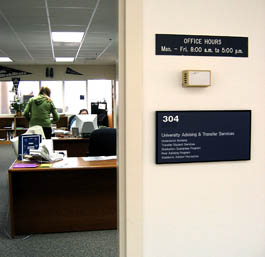
New Advising Center offers students more options
Undeclared students have another resource to help make decisions concerning majors and what college courses to take.
The new University Advising and Transfer Service Center was created to orient freshmen and sophomores with their studies programming, John Mortensen, director of the University Advising and Transfer Service Center, said. There are five new advisors in the center and are cross-trained to familiarize students with different areas of study, he said.
Mortensen said before the center opened, students had to meet with advisors from different departments to experiment their career possibilities. Advisors are cross-trained to give general information about all majors offered by Utah State University, he said, which helps students plan their schedules.
Deborah Reece, adviser, said the difference between the advisers in the center and department advisers, is that advisors from departments concentrate in a specific area of study.
“I used to work for the physics department and I used to know all about that. If a student wanted to change majors and come to ask me about it, I couldn’t answer,” Reece said, “now I can help those students too.”
Mortensen said the advising center is working more closely with the Career Center.
“Our advisors are learning more about career exploration tools and with that they will be able to help more students,” he said.
The advisers in the Advising Center are familiarized with university regulations and requirements from previous postitions held as department advisers, he said.
The Advising Center will benefit the students from the College of Humanities, Arts and Social Sciences, Mortensen said. Last year the College of HASS advisors were responsible for counseling undeclared students as well as the HASS majors.
“The ratio of students per advisors in the College of HASS came close to 900 to 1. For this year the expectations are that the number will fall to 400 to 1,” Mortensen said.
Heidi Evans, academic vice president of Associated Students of USU, said “This year the Advising Center is taking all the undeclared freshmen from the College of HASS and next year it will take care of all undeclared majors.”
Evans said the original project had six news advisers but due to the costs to set up the office there are five. However, the sixth adviser will start working fall 2005, Evans said. With the new advisers and reduced number of students, Evans said, students will receive more personalized service.
Evans said the number of students per adviser is still high. ASUSU is working with the Advising Center to increase the number of Peer Advisors, she said. Peer Advisors are juniors and seniors students that have already been to the requirement and general education classes and can help answer student questions, she said.
So far, the opinions about the new Advising Center are controversial. Students from the College of HASS like the center because it is easier to get an appointment with advisers. However, students from others colleges feel that the number of students in their advising services needs to decrease as well.
Juan Franco, vice president of students service, said the new Advising Center is part of the investment made with the Tier II tuition money and was voted by the students.
“Students pay two levels of tuition, Tier I is pretty much controlled by the state and Tier II is the part destined to the institution,” Franco said “usually administration and students decide what it is going to be used for.”
To make the adviser’s work easier, the university is planning a new catalog, Franco said. So far, the catalog is a biennial publication, however, starting next year, it will be published annually, France said. The annual publication will keep students updated with the changes in marjor requirements, he said, and it will also contain a four- year planner for students to map out classes.
The catalog works as a contract with the students, France said. The biennial publication was causing expenses to the departments due to changes made in between publications. Now, major sheets, printed mainly to correct the catalog will not be as used as before, he said. The sheets will still be available for students, but the university expects not as many students will use them, Franco said.
According to the General Catalog Coordinating Committee Minute issued on Sept. 8, the catalog will also contain a list with standards GPAs for each major which will allow students to plan course schedules ahead.
-acantunes@cc.usu.edu