
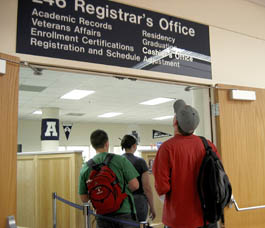
Graduation process frustrates seniors
As the graduation application deadline approaches many students are either rushing, or are unable, to get their packets in on time – even those who started the process at the recommended time.
Natalie Olsen, a senior majoring in social work who plans to graduate in Spring 2005, said she applied for her graduation packet during the second or third week of school, shortly after receiving an e-mail telling her to do so. She said she was originally told that her packet would be ready on Oct. 5. When she went to the Registrar’s Office then, she said she was told the system was down and she would have to wait a few more days. She received the same response a few days later.
“I’m really going to be pushing it,” Olsen said. “They should give students more time when it’s their fault.”
Olsen said she worries she won’t have enough time to get the signatures required for her graduation packet to be complete before the Oct. 15 deadline.
Associate Registrar Heidi Beck said when it is the institution’s fault, the late fee of $100 will be waived.
About 3,000 students apply for graduation each year. Two years ago, 60 percent of them applied late, Beck said. It was for this reason the late fee was initiated last year, and Beck said she thinks fewer than 20 students will have to pay it.
The graduation process for a student includes applying to receive a graduation packet, either online or at the Registrar’s Office. The packet lists the students major(s), minor(s) and classes needed to graduate. Upon receiving the packet, Beck said, the student must gather signatures from their respective college and department. The packet is then turned in and processed. If the packet is not turned in by Oct. 15 the student is charged a $100 late fee.
Students were encouraged to apply for graduation early because at the first of the year the Registrar’s Office is busy with many other tasks, including posting degrees for summer graduates, creating packets for spring (and this year, fall) graduates and adding and dropping classes and payments, Beck said.
Another reason to turn packets in early, Beck said, is to make sure that students are on the right track for graduation.
“The deadlines are not arbitrary and have been discussed by the advisers with the good of the students in mind,” Beck said.
Another reason students don’t get their packets back in time is because of their own mistakes, Beck said. When students list their major, minor, emphasis or repeated classes incorrectly, they are notified, asked to make the needed changes and start the process over by applying again.
Many have been frustrated by the delays this year and possible punishments, including Reid Furniss, a journalism department staff assistant, who has helped students with the graduation process.
“This is one of the years that has been really horrible,” Furniss said.
Furniss said he believes the packets are too much responsibility for the Registrar’s office and that is what causes such a bottleneck. Everything worked better when it was more the responsibility of the departments, he said.
“This process really needs to be looked at,” Furniss said.
The new packet process for the Registrar’s Office entails checking the applications and student transcripts for discrepancies and manually calculating the credits required by the state and by degree, Beck said, and eventually this part of the process will be automated. The packet is then given to the student and returned with the needed signatures. A $10 fee is also charged which goes toward general commencement costs, she said.
Beck said that although it will be hard to trust a new system, the university is committed to making it work.
“We recognize a very serious need to modify the application process. We are contacting other schools to see what the best practices are. The ad hoc committee is looking at the process very closely,” Beck said.
-hilaryi@cc.usu.edu