
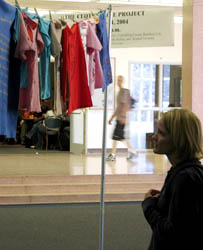
Clothesline Project stirs emotion in TSC
More than 100 shirts designed by female survivors of violence hang in the Taggart Center Student Center this week as part of the Clothesline Project – an event created to increase awareness, celebrate strength and “break the silence.”
The project is hosted by the Women’s Center and the collection of shirts increases each year, Janet Osbourn, the director of the Women’s Center, said.
“This is another step in having a voice and not just being a victim,” Osbourn said. “By designing a shirt, women become a more active participant in their healing process. This may be the first part of saying ‘I am a survivor.'”
A display created by the Women’s Center explained the structure of the clothesline was used because for decades women have communicated with each other while hanging clothes.
“We are publicly ‘airing’ our dirty laundry,” Osbourn said.
Teresa Eller, a senior majoring in broadcast journalism, is a survivor of violence who designed a shirt this year.
“Women need to know that it’s OK to talk about it,” she said. “We did not cause, we did not instigate [the violence].”
Eller said she also uses writing as an outlet.
“The more I wrote poetry, the less I became a victim and more a survivor,” she said.
Eller said her shirt will probably contain one of her poems and a picture. She said she hopes to reach out to other victims. The average woman will leave her abuser six times before really leaving, she said.
“I want people to know that they can be a survivor too,” she said.
Other women see the shirts lined up side-by-side and they see they’re not alone, Osbourn said. When viewing the shirts, it is important to keep the display in context, she said.
“People are sometimes offended because messages are violently graphic, but what happened to them was violently graphic,” she said.
Ashley Nielson, a senior majoring in family and human development, said it is difficult to see the shirts hanging in the TSC. Nielson said she was especially struck by the shirt showing a man with a gun to a woman’s head.
“The ones with really graphic pictures kind-of make me uncomfortable, but sometimes we need to be uncomfortable for change to happen,” Nielson said.
Some other messages on the shirts include, “I am not a piece of property,” and “silence is the perpetrator’s greatest weapon.” Also hanging is an infant body suit with “Two weeks old and already a victim,” written on the front.
“I hope people viewing the shirts who have not been affected by violence will become educated about what’s in our mind and heart and not put us in a stereotype,” Eller said.
Matt Howard, a forestry junior, said he felt angry while he was looking at the clothesline. “It makes me mad that this stuff still happens,” he said.
Howard said he knows someone who had an experience with violence more than 20 years ago and the effects are still evident.
“I can’t believe someone can be so selfish with someone else’s life,” he said.
Osbourn said the shirts also provide for reflections about one’s own relationships.
“I can’t say I really understand, but I feel grateful to come from a good loving family,” Loni Parkin, a sophomore studying dental hygiene, said.
The Clothesline Project was started in 1990 by the Cape Cod Women’s Agenda in Massachusetts. Utah State University hung its first clothesline in 1993, Osbourn said.
“It is a lot of work to make a clothesline and a lot depends on the women finding the courage. It is a difficult and very emotional experience,” she said.
The Women’s Center provides art supplies and a private space for those who want to design a shirt, Osbourn said, a survivor may design the shirt alone or with friends and family.
“We don’t make judgment of right or wrong,” she said. “[Designing a shirt] is an avenue for a person who feels violence was done to them.
The project is only for women survivors, but Osbourn said she is concerned for men who are victims of domestic violence.
“It is difficult because of the concern of masculinity. Many men are afraid to talk because they think they won’t be seen as real men,” she said.
Osbourn said she would love to see a parallel Clothesline Project for men.
“We have been looking for this for several years. We just need men to contact us so that we can shape something for them,” she said.
The only other rule for the Clothesline project is that the full name of the perpetrator may not be printed for legal issues, Osbourn said.
“If you can acknowledge that another person did this to you by name, it makes it real,” she said.
Several tables with information and other displays are also set up with the Clothesline project. In conjunction with the Clothesline Project, a two-part poetry workshop will be held for people victimized by violence and abuse. The workshop is free to men and women, but pre-registration is required. The workshops will be held from 6-8 p.m. Oct. 12 and 14. For more information, call the Women’s Center at 797-1728.
The Sexual Assault Anti-violence Information Office (SAVVI) and Community Abuse Prevention Services Agency (CAPSA) were also involved in the Clothesline Project and are available to help anyone who has been effected by violence.
-ashschiller@cc.usu.edu