

How USU students can find jobs in natural resources
Utah State University students studying natural resources are navigating a changing job landscape as federal hiring freezes and shifting government priorities affect available jobs and planned career paths.
Students majoring in fields such as wildlife ecology and environmental management have historically pursued jobs with federal agencies such as the U.S. Forest Service or National Park Service. However, policy changes and workforce shifts over the past few years have created uncertainty for some students preparing to enter the workforce.
On United States President Donald Trump’s first day in office on Jan. 20, 2025, he implemented a federal hiring freeze. As stated on whitehouse.gov, no vacant federal civilian position “may be filled, and no new position may be created except as otherwise provided for in this memorandum or other applicable law.”
The freeze was extended multiple times, pushing back the end date. An executive order released by Trump on Oct. 15, 2025, titled “Ensuring Continued Accountability in Federal Hiring,” maintained ongoing limits on federal hiring and required agencies to receive approval before filling certain positions.
Despite the ambiguity surrounding finding work for natural resources students, there are resources offered by USU to assist in the process. Peter Howe is the associate dean for strategic academic initiatives in the S.J. and Jessie E. Quinney College of Agriculture and Natural Resources and is involved in coordinating the college’s internship program.
This program has partnerships with agencies such as the Forest Service, National Park Service and the Utah Division of Wildlife Resources.
“Over the past couple of years, there’s certainly been some variation in the jobs that are available and the timing when they’re offered,” Howe said. “Because of the employment changes that have happened, hiring freezes and some layoffs at the federal level, these agencies are finding that these are really critical positions.”
This realization, according to Howe, has encouraged these agencies to increase staffing for the summer 2026 season. He believes that students should feel optimistic about finding jobs.
 Rylee Patterson
 A student studies in the NR building on USU campus, as seen on Feb. 24.
“More and more positions are being listed, particularly for seasonal technical positions through places like the Forest Service,” Howe said. “When you look at positions such as ones involved in wildfire management, there’s understandably a big need for people to fill those roles.”
One USU resource Howe encouraged students to take advantage of is the natural resources peer advisers. Based in the Natural Resources Building, these peer advisers help with things like preparing a federal resume and navigating federal hiring platforms.
One of these peer advisers is Kennedy Price, a student majoring in wildlife ecology and management and the president of the USU student chapter of the Wildlife Society. Being a senior, Price has experienced navigating the current job market.
“I’m a peer adviser this year because it was so helpful to me when I was trying to find a job,” Price said. “They can tell you what the best job boards are, how to fix your resume and how to write a cover letter.”
Price explained there are different resumes needed for applying for a federal job, a job with state departments or nonprofit organization jobs.
A lot of federal jobs are posted with deadlines that have a very quick turnaround, as emphasized by Howe, adding to the challenge of securing one.
“I’d say check back often and look for keywords like ‘forestry,’ ‘wildfire’ or ‘natural resources,’” Howe said. “We also have an email list in natural resources that any student at USU can subscribe to, where we send around job opportunities.”
According to qanr.usu.edu, the QANR has a 75% job placement rate upon graduation. The website states another 10% of graduates move on to advanced degree programs, suggesting 85% of students get opportunities within the field.
Price clarified that hiring season is from November to March, when many apply to seasonal summer jobs, grad school or what she referred to as “real big kid jobs.”
“This year has definitely been better. A lot of those cuts happened right before hiring season last year,” Price said. “It was kind of a disaster because all of those got cut, the government got shut down and funding got pulled out. I think we’re kind of on the up and up now.”
USU hosts several federally-funded labs such as the Utah Water Research Laboratory, the United States Department of Agriculture Bee Biology and Systematics Laboratory and the USDA Poisonous Plant Research Laboratory. Many labs require student technician support, offering opportunities for undergraduate and graduate students.
“There’s certainly been some shifts and some projects that have been paused,” Howe said. “But I think, generally, I’m really happy that we’re still able to provide a lot of these job opportunities for students.”
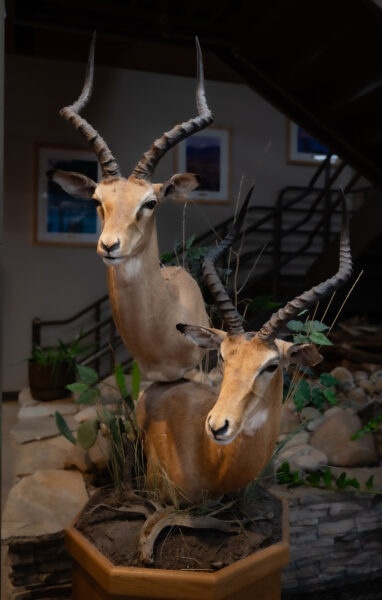 Rylee Patterson
 Taxidermy antelopes featured on the first floor of the NR building, as seen on Feb. 24.
The internship program within QANR is hiring for summer 2026 positions that only USU students are eligible for. Howe advises students to access qanr.usu.edu’s “Jobs and Opportunities” page to take advantage.
As a student, Price said she believes federal natural resources jobs used to feel the most stable and consistent.
“There was always a place, always a job with great benefits. Once you’re in, you’re in forever. With the changing politics, that’s not true anymore,” Price said. “That was a foundational truth in the natural resources, and that shook a lot of people, and I don’t know if people have bounced back from that.”
Price equated finding a job to being lost at sea but said USU’s resources have offered students a way to be tethered.
“Natural resources is a pretty big community, and we’re all in the same spot trying to find a job for the summer,” Price said.