

New nature parks offer gateway to outdoor learning for students and community
Cache Valley residents will soon have expanded opportunities to explore nature and learn about the environment with the development of the Nibley Outdoor Classroom.
The project aims to create spaces where children, families and community members can engage with wildlife, local ecosystems and outdoor recreation while building skills and confidence.
Interest in the site has already grown as visible improvements take shape.
“People suddenly noticed it when we put the gate in. People started coming in like, ‘What is it with the gate?’” said Kendra Penry, executive director of Stokes Nature Center.
Developed by the center, the outdoor classroom features two pavilions, a pollinator and food garden, an indigenous garden and protected wildlife habitats. The site is designed to host school programs, university research and community events while providing accessible outdoor experiences for visitors of all ages.
Jordan Smith, outdoor recreation and tourism professor at Utah State University, said spaces like this provide something many children lack.
“These nature parks are not entirely new but offer a very different flavor of outdoor exploration and play than kids are traditionally used to,” Smith said.
Over time, Smith said, playgrounds have become increasingly structured and safety-focused, sometimes limiting opportunities for independence and exploration.
“These new nature parks offer just that opportunity for a little bit more risky play that allows them to develop a little bit more capacity or capability in developing skills that they otherwise wouldn’t,” Smith said.
Research shows that supervised but self-directed play can help children build resilience, self-confidence and independence.
Smith added that preserving natural features rather than overdeveloping them is key to that experience.
“It’s helpful to have them to keep it natural and to not go over it with whatever kinds of things they want to build but just embrace what’s already there,” Smith said.
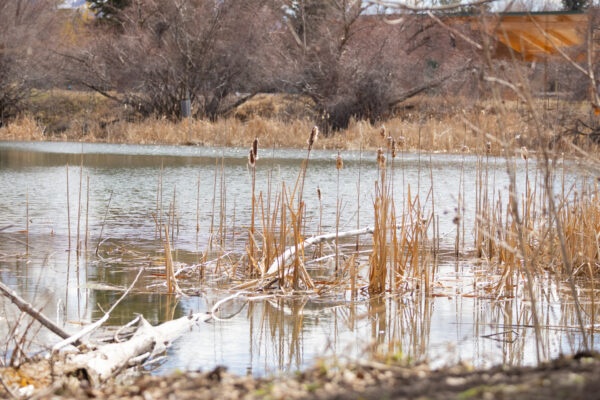 Sydnie Fonoti
 Wildlife pond at Stokes Nature Park on Feb. 26.
For many families, simply seeing natural spaces as places for recreation is not automatic.
“For a large proportion of our population, a large proportion of our kids, they don’t really think about those places as places to play — places to recreate,” Smith said.
Smith said many children don’t immediately see nearby outdoor spaces as places where they can spend time or explore nature.
“These types of more proximate or closer-to-home opportunities provide opportunities for kids who had never thought about maybe going camping — maybe never thought about going for a hike,” Smith said.
The Nibley site, donated to the center in 2003, has experienced construction delays due to weather and a nesting sandhill crane. The site is intended to serve groups ranging from elementary school students to university researchers.
“Quite a few schools … are excited about using it for their students to learn outside,” Penry said.
In addition to K-12 programming, university students will have opportunities to conduct soil and water quality testing, plant studies and interpretive signage projects.
“We’re open to ideas. If faculty or students want to use the space in ways that expand their learning and benefit the property, we’re interested,” Penry said.
Gardens are central to the classroom’s educational mission. A 65-bed pollinator and food garden is designed to accommodate children and adults of all abilities, reinforcing connections between ecosystems and everyday life.
“That’ll be a teaching garden, kind of like that connection between pollinators in our food supply,” Penry said.
Fruit trees along the front of the property provide harvests donated to local food pantries, while an indigenous garden introduces lessons on low-water and sustainable food practices.
“It raises food for the food pantry but also is a great programming opportunity about low-water-usage food and will feed them well with healthy and fresh foods,” Penry said.
Wildlife conservation is another key focus. The property is managed to allow animals to thrive, giving visitors opportunities to witness natural interactions firsthand.
“We had a day where we saw a bald eagle flying and started dive-bombing a duck on the lake, and I was like, ‘That is what we’re here to do — is to create chances for people to see that,’” Penry said.
Smith said these experiences can shape how children understand their environment.
“It opens them up to things that we maybe haven’t thought about before. It might be something that they want to encourage more than they would have if that kid didn’t have the opportunity to do it at a local playground,” Smith said.
Accessibility also played a role in selecting the Nibley location. While the Logan Canyon nature center offers valuable programming, Penry said it can be more difficult for some families to access.
“This is just much simpler. Once you get here, parking is easy, and the simpler we can make it for people, the more likely they are to get outside,” Penry said.
Beyond education and recreation, both Smith and Penry emphasized the importance of small, meaningful outdoor moments.
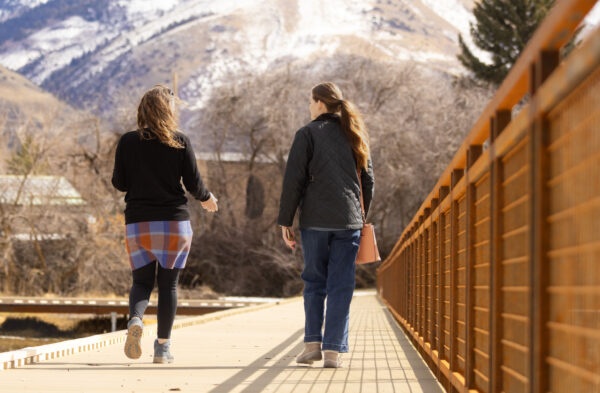 Sydnie Fonoti
 Executive Director Kendra Penry gives statesman reporter Jayke Martin a tour of the Stokes Nature Park on Feb. 26.
“We do our hummingbird hand-feeding nights, and it’s so simple. There’s no TV, your phone’s not going to work, and that’s what we’re hoping for — is these small, little experiences that 20 years from now, is a core memory,” Penry said.
The ecosystems at Nibley differ from those found in the canyon, offering visitors the chance to observe distinct habitats within a short distance.
“We’re not going to have sandhill cranes nesting in the canyon, but they will here,” Penry said. “It shows how two ecosystems that feel close together are actually very distinct yet dependent on each other.”
Despite construction delays caused by nesting cranes and unpredictable weather, the Nibley Outdoor Classroom is expected to be completed by late spring.
“We’re already doing programming. We’re just hoping we can finally call it done by late spring and then really get programming going,” Penry said.
Ultimately, organizers hope the site will inspire long-term engagement with the outdoors.
“These new nature parks get students out of the routine and lets them really choose their own adventure,” Smith said.