

The Clothesline Project returns to USU
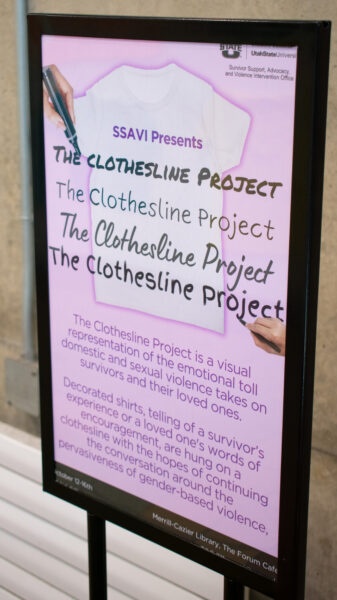
Shirts displaying “jarring” personal accounts of sexual assault and domestic violence hung from a clothesline at the entrance of Utah State University’s Merrill-Cazier Library as part of a nationwide initiative called the Clothesline Project.
Utah State students and members of the Logan community anonymously wrote messages on the shirts for the Oct. 12-16 exhibition, which was organized by the Survivor Support, Advocacy, and Violence Intervention Office, or SSAVI.
The Clothesline Project began in October 1990 in Cape Cod, Massachusetts, said Ashleigh Totten, the outreach coordinator for SSAVI.
According to Totten, a group of women wanted to visually show how terrifying the statistics were around sexual and domestic violence, so they decided to display messages and stories by writing on shirts and hanging them on a clothesline.
“It’s sort of jarring,” Totten said. “The installation, when it was initially created in the ‘90s, was meant to be jarring. It’s sort of an uncomfortable installation.”
This project now happens on many college campuses throughout the country, and it has been a tradition at Utah State for several years, Totten said.
According to previous reporting from The Utah Statesman, Utah State has been involved in the Clothesline Project since 1996.
“It operates pretty much the same as it did in the ‘90s,” Totten said. “Survivors can create shirts that share their story unfiltered about their experience with domestic or sexual violence or interpersonal harm.”
Two dozen shirts were created this year, with some sharing personal stories and others sharing words of encouragement to survivors.
“We don’t filter what people can say on the shirts, so some of them are pretty graphic,” Totten said.
When Utah State junior and SSAVI intern Aelin Smith saw the shirts, it took her a minute to take it all in.
“It really makes me slow down and think about the people that are actually in these situations,” Smith said.
Some of the shirts, Smith said, can be uncomfortable to look at.
“The project gives students a way to be brutally honest about what it is like to be a survivor of violence, and the real, hard emotions that come with it that maybe the public isn’t always comfortable receiving,” Smith said.
Totten said discomfort is part of the project’s purpose.
“I think it makes people a little uncomfortable, but my hope is that some of the shock value will encourage people to realize that violence really is happening on campus,” Totten said.
According to Totten, creating these shirts can help survivors express pain and grief, as well as spread awareness and education to the community.
“It can help survivors who maybe haven’t come forward, or who are struggling themselves, know that they are not alone and that other people in the community are experiencing this,” Totten said.
Totten thinks many people are unaware of how many people are victims of interpersonal harm.
“Statistically, we’re looking at probably thousands of students on this campus that have experienced some form of interpersonal harm in their life,” Totten said.
Totten hopes this project can help raise awareness of that.
“It allows people to really reflect on the fact that violence does happen in our communities. It happens on our college campuses. It happens in our towns. It happens in our cities,” Totten said.
Totten said the SSAVI office is available to students who have experienced any kind of interpersonal harm.
“We live in a time where a lot of survivors are questioned and not heard, and there’s a lot of active victim blaming,” Totten said.
The office, formerly known as the Sexual Assault and Anti-Violence Office, or SAAVI, updated its name to the Survivor Support, Advocacy, and Violence Intervention Office, or SSAVI, in August this year.
“A lot of people thought we only served students who had experienced sexual assault and rape,” Totten said. “That’s really not true.”
Totten said the new name better represents the services offered.
“We work with survivors who have experienced any type of harm, especially interpersonal harm,” Totten said, “but that ranges from stalking, bullying, roommate conflicts, all of those things, not just assault.”
 Elise Bliss
A sign for the SSAVI Clothesline Project is shown at the Merrill-Cazier Library on Oct. 16.
SSAVI provides free and confidential support to students, staff and faculty. More information about the office’s services and available resources can be found at usu.edu/ssavi/.
You must be logged in to post a comment.
There are no comments
Add yours