

A new story begins for St. Ann’s
A group of Utah State University students took a trip up Logan Canyon to tour a popular site of Cache Valley legend with the man who now owns the supposedly haunted property. He plans to turn what was once known as St. Ann’s Retreat or The Nunnery into a public resort.
Cameron Jensen, a Utah entrepreneur, knew once he saw the listing for the $700,000 abandoned property, he had to have it.
“Where else could I ever afford — meaning how cheap this place was, with all its issues — 10-plus cabins, a river and a 60-foot swimming pool,” Jensen said during the tour. “This was the only chance in my life to own something like this.”
Jensen said at the time of purchasing, he wasn’t aware of the scary stories surrounding the property.
According to USU Digital Exhibits, one version of the Cache Valley legend says after the property had been donated to the Roman Catholic Diocese of Salt Lake City in the 1950s, expecting nuns were taken to the retreat and hidden away. It is said that they killed their babies there, and at night you can still hear their cries.
After spending countless days and nights on the land and researching its true history, Jensen determined no such things took place.
“People wish,” Jensen said. “They’re always asking, and I would tell you. Trust me, I would. I would say, ‘Yes,’ and I would have a cool story to tell, but it’s just beautiful and not like that.”
The tour began in the Special Collections & Archives in the Merrill-Cazier Library, where Jensen was able to look over original architectural drawings, photographs and artifacts collected from the retreat when it was known as Hatch’s Camp.
“I’m historically restoring this, so we needed these, and we could not find them anywhere,” Jensen said. “Because you guys had them on hand, we were able to see how to bring this place back, because otherwise, we’d have been hosed.”
One aspect of the property’s past Jensen does believe in is the traffic it receives from legend-tripping trespassers who come to graffiti, smash windows and party. He said the consistent vandalism contributed to why the property remained abandoned for so long.
“They’d work a couple months and then get overwhelmed with the vandalism, and they would just desperately sell it to someone else,” Jensen said.
He said restoring decades of damage and preventing future damage has been made possible through Starlink internet, which allows him to survey and protect the property against trespassers.
“Modern owners did nothing but botch the properties, and that’s because they could because it wasn’t registered or protected until 2006,” Jensen said. “So that’s where I’m coming in and having to historically restore, meaning undo all their crap to put it back to how it was.”
Obtaining the architectural drawings from USU Special Collections & Archives was only one piece of the restoration process, according to Jensen. The property didn’t have access to clean water for decades until he started restoring the original water line.
“It took three months to fix,” Jensen said.
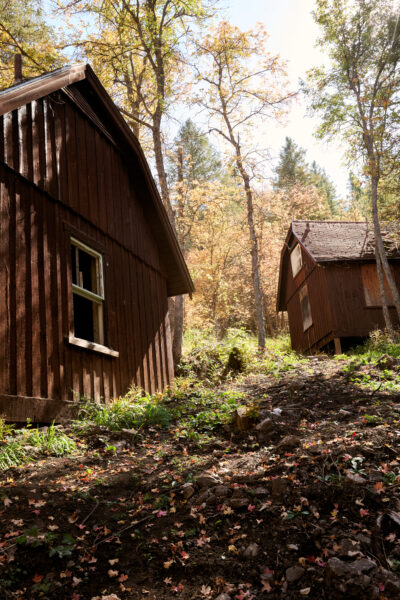
Cabins awaiting renovation at the recently acquired St. Ann’s retreat: a long-abandoned site in Logan Canyon on Oct. 8.
During those months, Jensen had to scale the mountain to the north of the property, locate the natural spring and unclog the water line.
Jensen said utility changes were also a large part of the process. All of the buildings needed new roofs, and the whole property needed electrical upgrades and a modernized septic tank, which Jensen showed to the tour group.
Despite the modern changes Jensen has to make in order for the resort to be safe for public use, he plans to restore everything that hasn’t already been damaged or modified beyond repair, but he said the usage of old-growth wood for the property’s original construction has made restoration easier.
“That’s why these things are still standing,” Jensen said. “This is old-growth wood, which you literally can’t find. It doesn’t exist anymore, but old growth is 100-plus years ago.”
Much of the original construction of the property still stands, including all the cabins, some glass windows and the swimming pool.
Jensen said once restoration is finished, the property will be open to the public for free and visitors can rent the venue for events or overnight stays. He said he hopes to have the boy’s cabin, girl’s cabin and swimming pool finished by 2027, along with the Hatch House, which will be converted into a coffee shop.
J.J. Watts, the USUSA executive vice president who organized the tour, said he did so to learn more about the restoration plans and to visit a site of scary stories he grew up hearing.
“It was way prettier than I thought — way more peaceful than I thought,” Watts said after the tour. “I felt like I could spend time here.”
Despite not subscribing to the property’s haunted history, Jensen said he knows the myths and legends will always be a part of its legacy.
“It’s not even a legend — it’s a legacy at this point,” he said. “Meaning you can’t kill a legacy, so it’s always going to be part of this property. I’m not necessarily going to lean into it, but if you’re
into the boogeyman, and you want to pay me to scare yourself, then by all means, pay me and come scare yourself.”
You must be logged in to post a comment.
There are no comments
Add yours