

USU provides aid in wake of Navajo Nation floods
Utah State University’s Heritage & Culture collected hygiene products, clothing and food for Navajo Nation families after flooding destroyed homes and closed roads in southern Utah.
Monsoon rains hit the Four Corners region in mid-September and started the flooding, Utah Public Radio reported. On Oct. 23, the San Juan River rose to 14 feet, breaking a record that had stood since 1909.
Faustine Saganey, program coordinator for Heritage & Culture, said the office started the drive right after the flooding. Donations were collected in the Native American Student Lounge, TSC Room 326, with a list that included feminine products, hygiene products, new clothing and food.
“It was amazing to see not just the community but our students even coming in,” Saganey said.
Some students told her they used their last dollar or waited for a clearance price so they could afford to give, she said. The Native American Student Council donated $200 worth of items, and its adviser gave more on top of that.
Heritage & Culture worked with NavajoStrong, a relief organization led by Bud Frazier. Saganey knew Frazier’s program through Teresa and Curtis Frazier, who work as faculty at the Utah State Blanding campus and taught her when she studied there in 2015. NavajoStrong served as a halfway point, she said, so affected families would not be overwhelmed.
“We just wanted one streamlined process from us to give to NavajoStrong,” Saganey said.
Most USU Native American students are Navajo, Saganey said, and the flooding hit close to home for the office, including its student council.
Several students from Logan went home last week to be with affected families, Saganey said. The office sent them off with care packages from the Student Nutrition Access Center, and Jonathon Walters, program coordinator for the center, gave students money from his own pocket. Saganey and other co-workers did the same after learning students were pinching pennies to make the trip, which can take 10-12 hours each way.
“Gas is expensive, and it’s expensive to go home,” Saganey said.
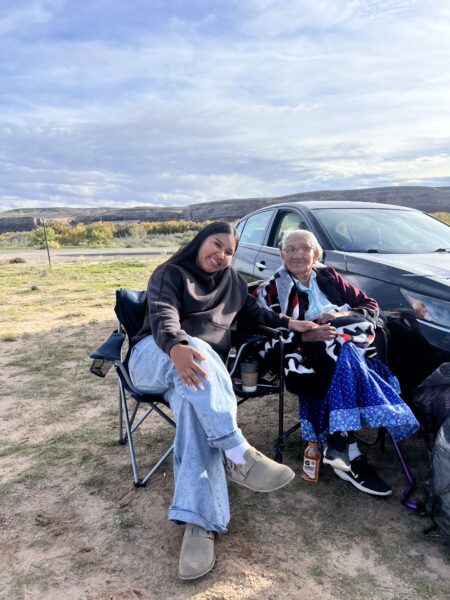
Etsitty visiting her grandmother in the Navajo Nation on Oct. 30.
One of those students was Tzosilah Etsitty, a junior studying veterinary science. Etsitty’s grandmother lives near the river in Bluff, and her house was fully flooded. Her grandmother is 98, raises sheep and is fluent only in Navajo, Etsitty said.
“She lost a hogan. She lost her newly built house, her vehicles,” Etsitty said. “Luckily, they got most of her livestock out.”
Her grandmother stayed with Etsitty’s parents for the first week and was able to take only three pairs of clothes, a little food and, Etsitty said, her prayers to keep her home safe.
Etsitty said she was homesick and eager to go home, especially during midterms. Her mother called and showed her grandmother, who spoke to her in Navajo.
“My child, my heart hurts,” her grandmother told her in Navajo, Etsitty said. “It just really hit me at the time of when I wanted to go home and I needed to go home.”
Etsitty said she told Saganey and another staff member how badly she needed to go home, and they directed her to the care center, which provided counseling. She also applied for a scholarship and received it on her way home. She used the money to buy new clothes for her grandmother and two uncles and put the rest into her grandmother’s account. She also brought food and made her grandmother home-cooked meals and soups.
“The university has really helped,” Etsitty said.
Relatives who had traveled a long way were also there to see her grandmother, who no longer remembers names but remembers faces and calls family members by sweet words instead, Etsitty said.
“It just kind of like really warmed my heart to see our families come together,” Etsitty said.
Saganey said the damage is far from over. Flooding has spread to other parts of the reservation, including near Flagstaff, Arizona, and many roads and bridges are closed.
Chapter houses and groups such as the Utah Navajo Trust Fund are also trying to help, she said. The part that hurts most, she said, is that many families probably lost their livestock.
USU Blanding is also planning to help rebuild roads once the water recedes, UPR reported. Ken Guan, president of USU Blanding, said the university will contribute equipment, expertise and labor. The project will take at least three more months, he said.
For Etsitty, the Native American Student Lounge has become a place where staff check on whether students have eaten and slept.
“Being here just makes me feel more seen, more known,” Etsitty said.
You must be logged in to post a comment.
There are no comments
Add yours