

‘Nuisance’ beavers given a second chance
Often seen as a nuisance, one rodent is playing an important role in Utah’s efforts to conserve water and restore local ecosystems.
At Utah State University, the Beaver Ecology & Relocation Collaborative, or BERC, is giving beavers a second chance while helping put their natural engineering abilities to use in Utah’s watersheds.
When beavers create problems for landowners by flooding property or chewing up infrastructure, BERC offers to live-trap the rodents and relocate them to waterways where their behavior can benefit the surrounding ecosystem.
“It’s a real win-win-win,” said Nate Norman, the lead field biologist of BERC.
He described the project as a win for landowners, beavers and the environment.
“I love the fact that it’s good for the beaver, because it gives them a second chance,” Norman said. “They didn’t mean to cause problems. They just end up in the wrong place sometimes.”
Typically, nuisance beavers face lethal injection, Norman said.
After the beavers are trapped, they are quarantined for at least three days in the Beaver Bunkhouse, located in Millville.
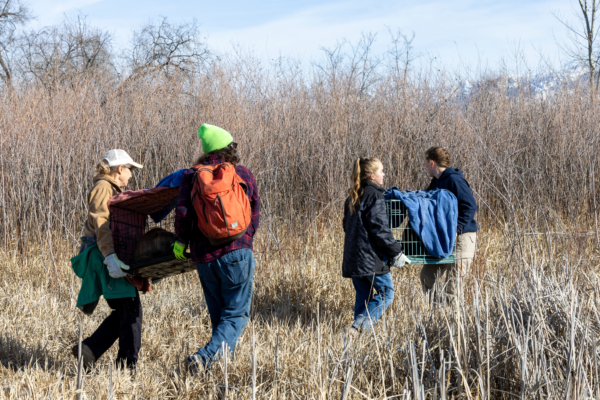
While in the bunkhouse, Norman said researchers determine the sex and health of the beaver. The beaver also receives a Passive Integrated Transponder, or PIT tag, inserted into its tail. This microchip helps researchers monitor the animal once it’s released.
The beavers are often relocated with a colony or mate, Norman said.
After the quarantine period, BERC works with the Utah Division of Wildlife Resources and the U.S. Forest Service to identify an area in Utah where the beaver should be released.
“In the springtime, we have a big snow melt, and a lot of water comes down the mountain in a short period of time, causing flooding issues, erosion, and then later in the summer, everything dries up and we have no water,” Norman said.
Norman said beavers can help combat this issue.
“All the little beaver dams help slow down all that water, reduce the flooding, and then the water slowly trickles out through the summer, creating more water for us to use,” Norman said.
Norman said his favorite example of this is one of the first relocations he was involved with several years ago.
One rancher from Preston, Idaho, Jay Wilde, noticed his stream was going dry, and he couldn’t get the water he needed to irrigate his crops and pastures for his cattle, Norman said.
“He worked with USU in getting some beavers relocated there,” Norman said. “Now, they’ve been able to monitor that stream, and over the last few years, the stream — which used to go dry in the early spring — has been flowing all year long.”
Now that the program is more developed, Norman said relocations can only happen within the state of Utah. Beavers are frequently relocated to the Uinta Mountains or in southern Utah by Zion National Park.
According to Natalie D’Souza, a BERC researcher, the benefits of beaver dams extend beyond water conservation.
“Utah’s in a drought-stricken state right now,” D’Souza said. “We’re really low on water, and beavers do this incredible thing where they build up riparian areas.”
D’Souza described these areas as the wet, vegetated areas between land and water systems.
“Most species in the state rely on riparian systems for forage shelter and water stability,” D’Souza said. “Beavers are also supporting so many species, and they call them ‘keystone species’ because of that.”
These beaver habitats create another unexpected benefit.
“What’s really cool about beavers is those really wet habitats that they’re creating,” D’Souza said. “Our research is finding that they’ve become fire resilient because they’re so wet and spongy that wildfires approaching them will actually stop at the beaver complexes because all that wetness dampens the fires.”
This creates more resilient landscapes that humans benefit from, according to D’Souza.
“They’re doing much more good than humans could, and they don’t have a salary.” D’Souza said.
D’Souza got to witness this firsthand in a canyon near Spanish Fork, Utah.
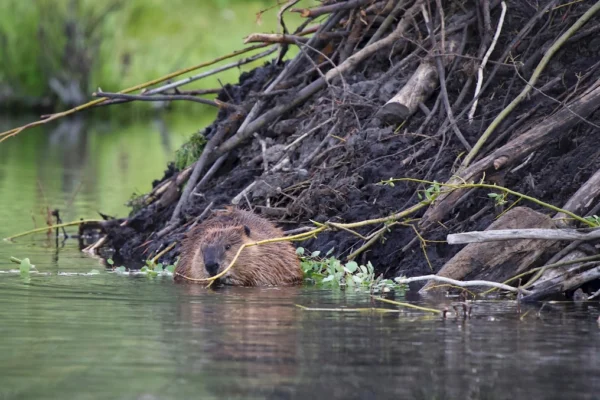
According to D’Souza, a fire had decimated the canyon, and she was sent with a team to help restore the stream that ran through it.
“When I first arrived, I was like, ‘Oh, this is rough,’” D’Souza said. “There were burned logs everywhere, barely any grass on the hillsides, it looked like a Martian landscape.”
BERC relocated some beavers to this canyon to help.
“We turned this bend, and then all of the sudden it was like this beautiful mecca of a riparian area from this beaver we had relocated,” D’Souza said. “It was thriving and taking advantage of the little forage that was left.”
This year, the program relocated around 90 beavers, said Alex Fortin, a BERC researcher.
Fortin and D’Souza, a married couple, are currently working together on a two-year research project, funded by a grant, studying which factors influence beavers staying in the area they were relocated to.
“Since beaver relocations are booming in the state, we want to make sure we’re relocating in the best locations possible,” D’Souza said.
D’Souza said one of the biggest challenges of the project is finding the relocated beavers.
“Out of the 64 beavers we put tags on, we found five,” D’Souza said.
Fortin said it’s rewarding when one is located.
One beaver they were looking for was found in Logan Canyon last summer.
“I wasn’t really expecting much. There’s beavers everywhere,” Fortin said. “We didn’t know if it was just a naturally occurring one or if it was ours, but we used our equipment just to check and sure enough, we got a hit on a pit tag that was inserted into that beaver’s tail five years ago.”
Fortin and D’Souza’s research project is expected to be finished at the end of this year.
“I think it’s cool to be able to kind of jumpstart the monitoring, and it’s just something that’s been kind of lacking in beaver relocation in general, so it’s kind of rewarding to me,” Fortin said.
The BERC program is a non-profit that runs off grants and volunteers, D’Souza said.
“I’d highly encourage people to get involved, there’s so many opportunities to do research like Alex and I do,” D’Souza said. “You can also assist with live trapping the beavers, which is incredible hands-on experience.”
For more information on BERC, visit beaver.restoration.usu.edu.
You must be logged in to post a comment.
There are no comments
Add yours