

Banned Books Week: The freedom to read
Libraries around the country and Cache Valley celebrated the freedom to read and raised awareness about the harms of censorship during Banned Books Week.
“The freedom to read is a core tenet of libraries. That’s why we’re here. It’s a key tenet of democracy, to be honest,” said Michael Sauers, director of the Logan Library. “With the exception of, say, a parent to their child, nobody has the right to tell other people what they can and can’t read.”
The Logan Library and Utah State University’s Merrill-Cazier Library hosted events and created displays to raise awareness.
“USU Libraries participates by providing our community with information concerning the most recent data from our professional organization, the American Library Association, about book challenges. We also often do a display because we know that people are sometimes surprised to know which books have been challenged or banned,” wrote Jennifer Duncan, USU dean for libraries, in an email to The Utah Statesman.
The Logan Library hosted an activity with the Logan chapter of the Silent Book Club, where members of the community gathered to make pins and write postcards to their representatives, opposing book bans.
Roz Bingham cofounded the Logan chapter last summer. The club meets twice a month to read together without the limitations of an assigned reading list.
“You get together with a bunch of other people who want to read or maybe are just trying to find some quiet time away from kids or away from work or anything like that,” Bingham said. “It gives introverts a way to socialize without having to actually socialize.”
Bingham believes in the importance of Banned Books Week and was excited for the opportunity to collaborate with the library.
When people ban books, she said, “They’re taking something that should be a personal choice, ‘I’m not going to read these books,’ and making it into ‘No one should read these books.’”
Bingham argued people often see banned books as dangerous without fully understanding them.
“When I was younger, they had banned the ‘His Dark Materials’ series because in the last book, they killed God,” she said. “That made me want to read the book more because I was a teenager. You’re telling me ‘No, now I have to do it.’”
After reading, she felt the God figure they killed in the book didn’t line up with the God she’d learned about in church.
“It sounded more like Lucifer,” she said.
This disparity made her question the ban, which she called “stupid” and reinforced her belief that “everyone has the freedom to choose the kind of things that they want to read.”
Duncan explained this week has been around since 1982 when Judith Krug, an American librarian, noticed a “significant uptick in the number of book challenges directed toward libraries,” Duncan wrote.
At the Logan Library, Sauers is concerned about the increasing trend of book banning.
“I’ve been in libraries for 30 years,” he said. “It’s always been in the background, but it’s never really been a direct concern. In the last couple of years, there have literally been thousands of challenges to book materials.”
Years ago, while Sauers was on a library board, someone objected to the Robin William’s comedy “Patch Adams” because they felt it didn’t accurately portray how doctors worked. The board created a subcommittee, who watched the movie, wrote a report and decided to keep it in the collection.
“Over the last few years, it’s changed,” Sauers said. “It’s not necessarily one-offs anymore. There are groups that create lists of books that they object to and then get people in communities to take the list of, say, 300 titles and go, ‘We completely disagree with this.’”
This hasn’t yet happened in Cache Valley, but Sauers said the library is prepared to defend its collection.
Sauers, Bingham and Duncan believe raising awareness is crucial.
“From my personal perspective, Banned Books Week is a critical tool that allows libraries and their supporters to reinforce the values of free speech and the freedom to read,” Duncan wrote. “There is a saying in the library world that ‘a truly great library contains something in it to offend everyone.’ It is important to be able to represent differing viewpoints and narratives so that all patrons can see themselves and their interests represented in our collections and that they can interrogate a wide variety of ideas.”
Sauers believes censorship is not only harmful because it violates the freedom to read but because reading from a variety of perspectives makes people better.
“The more informed we are, the better we can run a country, simply put,” he said. “And having diverse materials and diverse stories allows people to experience things that they themselves maybe do not experience. It increases empathy. It increases knowledge. And if you don’t want to know about that, you don’t have to know about that. But don’t prevent other people from learning about it.”
When asked how members of the community can protect their freedom to read, Sauers said, “Read. Use your library.”
When a book is called into question, Sauers said the board reviews circulation statistics to see if there is a demand for the material. Community members can also support the freedom to read by attending board meetings when book bans are on the agenda.
“If you see something like that on your library board agenda and there should be some sort of public speaking, public input, then show up,” Sauers said. “Say, ‘Hey, no, we need to keep this in the library.’”
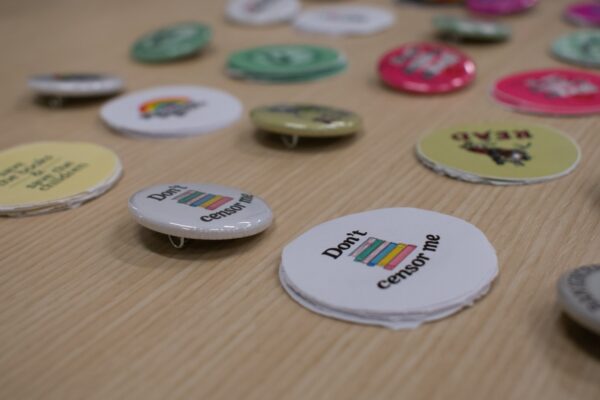
Pins on a table at the Logan Library’s Banned Books Week event as shown on Oct. 6.
Library materials and resources are available to everyone living within the Logan city limits, including college students.
“We like to joke that we have the fun books,” Sauers said. “No shade on the campus library. They’re wonderful. They have a great collection, but we’ve got ‘A Court of Thorn and Roses.’ We’re a couple blocks away, so come on down and get your library card.”
The Silent Book Club meets on the first Monday and third Saturday of the month at the Crepery at 29 W. Center St in Logan.