
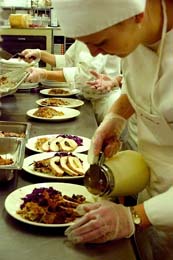
Culinary artists in training
Philosophy professor Chuck Johnson once asked, if the eye and the ear can experience art, why not the taste buds? Why do we discriminate against the other senses?
Although students in Erik Burlile’s history of world cuisine class may not be able to answer that question, they are definitely training to become culinary artists.
Every Friday morning, six culinary arts students meet to prepare and cook food from around the world. Tickets can be purchased for $9 and lunch is at noon in the Center Colony Room of the Taggart Student Center.
Each week the cuisine of a different country is represented. In February, so far, the young chefs have made Spanish, French and Italian food. Last Friday was German and Scandinavian day. This Friday African food is the specialty.
“This class is an exploration of history and practices of world cuisines,” said Burlile, the program administrator for culinary arts program, which he says has 35 to 40 students.
He said that a country’s food is often based not just on what’s available, but on the nation’s history and geography. The students use this information to design the menu each week.
The menu is usually planned about a week before the big day. For Africa’s entree, the students decided to cook Moroccan chicken in orange sauce.
Steven Anderson, president of the Culinary Arts Club, says this has been his favorite class in the four-year program.
“It’s kind of fun to get in here and we just play,” Anderson said. “Some people think it’s work, but we just play.”
Claire Tolman, a business minor, said one reason the major is so fun is that many of the classes are hands-on.
“This is way more fun than sitting in a lecture,” she said.
Burlile said a culinary arts major can choose among one of three minors at USU: human resources, accounting and business management/administration. Burlile actually went to school and did an apprenticeship at Harrah’s, in Lake Tahoe, Nev. He said it’s sanctioned by the American Culinary Federation, the No. 1 chef’s association in the United States.
As an expert, Burlile pointed out some of the most common errors of amateur cooks could be easily corrected, such as overcooking.
“Everyone in the United States has this concern, they cook the pork way too much,” Burlile said. “It’s always overcooked.”
Burlile said everybody’s mom “made porkchops that were all like shingles.”
“Pork doesn’t have to be cooked that way to be safe,” Burlile said.
The art of cuisine is a lot more than just cooking, though. Of great importance is how the food looks on the plate.
“When you order food, you look at it. That’s the first thing you do,” Burlile said. “You look at it when it’s coming across the room and you’re making judgments right off the bat.”
For some students, plating – arranging food on a plate for serving – is as rewarding as the cooking.
“I love the creativity of plating the food,” said Jessica Joerger, who declared culinary arts as her major during her junior year. “It’s all about aesthetics.”
Burlile also mentioned the importance of including complementary flavors. A plate should have a noticeable blend of sweet, sour, and other stronger complex flavors. Texture is also taken into account: When students make the menus, they always make sure there’s something crispy, chewy and creamy, “so your mouth never gets bored,” said Burlile.
Friday’s entree was German roasted pork stuffed with dried apricots, prunes, walnuts and apples. It was served in goat cheese sauce. The appetizer was onion slaw with caraway flatbread and gavelock salmon. Side dishes included “rosti” potatoes (like hashbrowns) and braised red cabbage. Tuille, a breaded cone filled with strawberries and Bavarian cream, was the dessert.
The meals served in this class are much more elaborate than the ones in another class Burlile teaches. The a la carte class members meet on Tuesdays and prepare, cook and serve a meal in three hours. Burlile also teaches a course called the business of feeding.
Although the chefs love cooking, many don’t really have a favorite food to cook.
For Burlile, “it depends on the season.”
“Everything is freshest during its time of year,” Burlile said. “Right now, for example, during wintertime, we like roasts with heavy flavors, and preserved fruits like apricots and dates.”
Anderson said, “I don’t really have a favorite. I’m just so good that I can do anything,” he added, laughing.
The culinary expertise possessed by aspiring chefs is important for their goals, which are as varied as the foods they prepare.
Jeremiah Sentz, who transferred from Penn State, said he wants to be a culinary arts teacher.
Anderson has a long-term goal of owning a restaurant. Next year, however, he hopes to find a good position in a hotel restaurant, to learn the business better.
“A lot of people have the dream of owning their own restaurant,” said Sentz, a marketing minor. “But I get more out of giving the knowledge and passing it on. You can’t say enough about how great a feeling that is. It lasts a lifetime.”
The culinary arts program will have a fundraising dinner near the end of the semester. For details, contact Erik Burlile at eburlile@cc.usu.edu or 797-8122 or Steve Anderson at stand@cc.usu.edu.
-marklaroc@cc.usu.edu

Tuille, a German dessert, waits to be eaten Friday afternoon. Every Friday the culinary arts students cook and serve food from all around the world in the Center Colony Room (Room 221). Tickets are $9. (Photo by Michael Sharp)