
Down to the wire
A bomb technician with sweat beading down his face stands before an elaborate combination of timers, explosives and multi-colored wires. As the music swells, he cuts the red one.
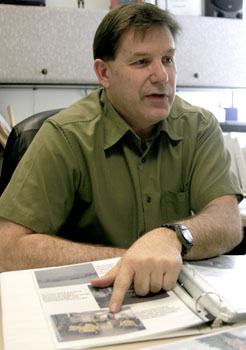
That’s Hollywood though. Reality, according to Utah State University’s own professional bomb technician Lt. Steve Milne of the USU police department, is never so simple.
“There’s no rule saying what color the wire to cut is supposed to be,” he said.
Milne, along with Mitch Frost of the Sheriff’s office and Randy Cranear of Logan Fire Department, make up the Logan bomb squad that covers all of Northern Utah.
In total, Utah has eight bomb squads that provide coverage for the entire state, each with state-of-the-art equipment.
“We’re on par with just about any bomb squad,” Milne said.
The squad’s equipment includes X-ray machines, Kevlar bomb suits and a bomb-disposable robot.
The robot for Logan’s unit, which was only acquired last year, has a body frame made from high grade aluminum, runs on twin tracks and weighs around 800 pounds.
The robot is able to climb stairs and can shed its wheel’s in 30 seconds if needed to fit in a tighter hallway.
The robot runs on a standard 24-volt car battery and is operated by remote control from the squad’s trailer. The trailer serves a mobile bomb control base with the robot and the technician’s other equipment stored inside.
The robot has four cameras on it that the controller can use to navigate the machine. A spool of 2,500 feet of fiber optic cable is located on the back of the robot with a tension sensor that automatically unravels at the robot moves away from the trailer.
The images from the four cameras is sent back though the fiber optics to a monitor where the operator can toggle between camera views or set them up in a picture in picture set up.
Milne said there are robots with wireless capabilities but they are “limited to line of sight” and are therefore not as good for situations where the robot must get into buildings.
The surveillance camera, which sits on a tower on top of the robot, can be raised up to give the bomb technicians a better view of the area, can rotate almost 360 degrees and is equipped with a powerful zoom.
On the front of the robot is a disrupter and a grabber arm, both of which have their own cameras.
The disrupter is used to disarm devices when necessary. The grabber arm is use to open doors, move things out of the robot’s way and even to drag unconscious people out of dangerous situations.
Instructors at the Federal Bureau of Investigation’s Bomb School are so skilled with the operation of the grabber arm that they can hold a car key, place it in the lock and unlock the door.
“So far I haven’t found anyone willing to let me scratch up their doors to let me try that,” Milne said.
Through the arm, the robot can lift up to 100 pounds. and can drag a car in neutral.
The robot also has a two way radio on board so that it can be used in hostage negotiation situations.
The robots are made by Remotec Inc., a company located in Oak Ridge, Tenn., that specializes in making unmanned vehicle systems.
“We went with this one because it’s the standard in the field,” Milne said. Most of the other squads in Utah have similar models although the Utah County Sheriff’s office having Remotec’s largest unit, the “Wolverine.”
On top of their normal eight-week training from the FBI, bomb technician must train for an extra week to be certified to use the robot.
On the day that Milne picked up the robot he got his first call to use it.
“We had a call from Smithfield about a suspicious package,” he said. “We were able the get the robot out and use it to check in out.”
The package turned out not to be a bomb, but counterfeit money.
Milne has been in the field of dealing with explosives since 1983. Since then, the Unabomber has sent a package to the University of Utah and there has been talk that he could have been a USU student.
The police department wanted to have someone on hand to handle any future bombs. As a rookie eager to get more involved in law enforcement, Milne volunteered to go to the FBI’s school to be trained.
“The last week and a half was just going through various exercises in these staged situations,” Milne said. “They set some of them up so that you were bound to lose so you don’t get over confident.”
During the Olympics in Salt Lake City, the Utah bomb squads were joined by teams from around the country including groups from the FBI, Secret Service and the Los Angeles police department. The groups shared experience and trained each other along with ensure the safety of attendees.
The Utah squads were able to build some good relationships for later use, Milne said.
Most of the calls that Logan’s squads currently respond to are to suspicious packages that end up being false alarms, but it has been used to handle everything from pipe bombs to old hand grenades found in people’s garages.
Milne said he has also been to a call where a dummy bazooka charge was found in some bushes on campus.
“When I started it was like all I had was wire cutters, now I have all this new equipment,” Milne said.
After Sept. 11, 2001, the Homeland Security Act provided more money for bomb control. It also required all official bomb squads to have a certain level of equipment.
The average robot costs $150,000.
-steveshinney@cc.usu.edu
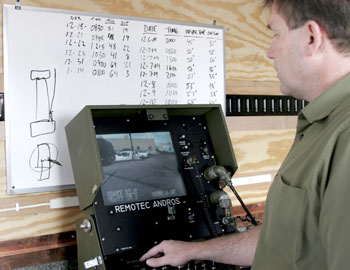
Milne controls Andros from a remote control system located in a trailer that house the bomb robot. USU Police received a grant for the robot last year. (Photo by John Zsiray)
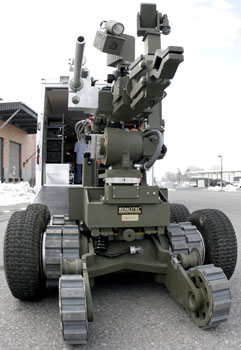
ANDROS the bomb robot belongs to the Logan bomb squad. The squad provides bomb coverage for Northern Utah and assisted with security in the 2002 Winter Olympics held in Salt Lake City. (Photo by John Zsiray)