
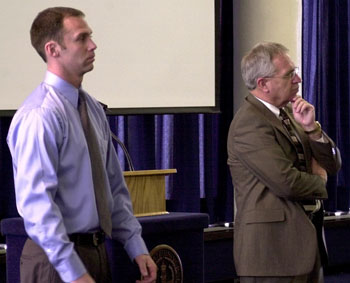
Tuition meeting explains reduction
Students can breathe a sigh of relief after Utah State University President Stan Albrecht promised them they won’t have to think about the proposed 43 percent tuition increase ever again.
While addressing students Tuesday afternoon in the Taggart Student Center, Albrechts said there will be a hike in tuition starting next Fall semester of about 9.65 percent for in-state, full-time undergraduate students. That takes tuition prices from $2,800 for 15-credit hours to $3,125. Out-of-state and foreign students will pay much more, according to figures from university officials.
USU has received no funding for fuel, power or maintenance from state lawmakers for several years, Albrecht said at the beginning of the Truth About Tuition meeting. The previously proposed Tier II tuition increase was designed to pay for those unfunded expenses.
Tuition hikes weren’t as large as originally feared when the Utah Legislature provided extra money for the state’s nine colleges and universities near the end of the session in Salt Lake City that closed March 1.
At USU, the current proposal calls for a 9.65 percent, an improvement over what the 13.5 percent that had been expected. Money from the tuition increase will go directly to the university in areas such as faculty compensation, operations budget, along will university and student initiatives.
Les Essig, president of the Associated Students of USU, supported both Albrecht and the tuition increase. Essig said $220,000 for student initiatives will go to improving temporary and peer-to-peer student advising, creating an intensive language-training program, beefing up counseling center services and starting a student investment fund.
Essig said the money will also be earmarked for the Provost Office to hire more math tutors in the TSC, improve technology and equipment in the Career Services Office and enhance wireless Internet on campus.
More money will also go to student scholarships, Albrecht said.
Interim Provost Noelle Cockett said it will be possible to reduce class fees because more money will flow to the operations budgets.
Other state schools, such as the University of Utah, Dixie State College and the College of Eastern Utah are designing tuition-increase proposals as well, Essig said. The hikes range from about 8 to 10.5 percent.
“I think it is very positive that we were able to decrease the Tier II tuition increase. I hope that everyone realizes the hard work of everyone involved in the process,” said Brian Francom, a freshman majoring in business administration.
Meanwhile, Cultural Vice President Syed Sayem was presented with a $10,016.30 check from faculty, staff and students for the Tsunami Relief Fund.
The money will be divided among the Prime Minister Office Fund in Sri Lanka, International Medical Corporation, Thailand Tsunami Relief Fund, South Indian Federation for Fisherman Society and the Red Cross.
-megliso@cc.usu.edu
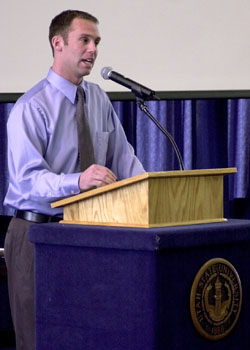
Les Essig speaks in support of the new tuition proposal and encourages other students to do the same. Essig spoke with President Stan Albrecht at the Truth About Tuition meeting. (Photo by Jamie Crane)