
Honoring a legacy
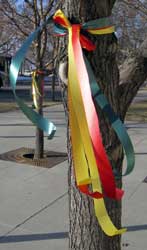
Since Wednesday, red, green and yellow ribbons have been tied to trees all over Utah State University’s campus.
Red stands for bloodshed, green stands for prosperous lands and yellow stands for wealth and prosperity, said Julie Anna James, vice president of the Black Student Union at USU.
The ribbons are just one of the organization’s efforts to raise students awareness of Black History month and of the African-American contributions in the history of the world, James said.
“We just want to educate those who want to learn and are willing to try something different,” James said. “We want to even educate ourselves as African- Americans because a lot of times, you don’t get that.
“It’s not necessarily what is in history books that you learn. We want to impress upon people that it is important to know where you come from so you know where you are going,” she said.
James is not alone in her acknowledgment of Black history. In fact, Black History Month has been recognized annually since 1926, according to www.infoplease.com.
Its original name, Negro History Week, can be accredited to the historian Carter G. Woodson who initially chose the second week of February to honor the birthdays of Frederick Douglass and Abraham Lincoln.
However, the month of February later was recognized for W.E.B. DuBois’ birthday, the passing of the 15th Amendment, the founding of the National Association for the Advancement of Colored People (NAACP), the assassination of Malcom X and other significant historical events.
Besides colored ribbons, the Black Student Union at USU has planned several activities designed to provide an exciting way to inform students about the significance of this month.
On Wednesday, students will be given the opportunity to enjoy a reading of original works of black history from 11:30 a.m.-1:30 p.m. in the Taggart Student Center Sunburst Lounge.
BSU has also arranged a discussion forum on diversity and adversity, an exploration of issues that relate to students of all backgrounds on Thursday. James describes the forum as a directed discussion involving the Affirmative Action Office and representatives of sociology and psychology.
Friday, BSU has planned a Soul Food Dinner in the TSC Ballroom. For $10, students are offered a taste of Southern-style cooking and a relaxing atmosphere to enjoy a sense of unity. Food became a big part of African-American culture, James said.
Among these activities will be performances including singing, drumming and dancing.
BSU hopes these activities will develop a sense of unity while also providing a means of information and dispelling stereotypes.
By learning from history, the Black Student Union hopes to continue ongoing progress that continually demands effort. Most importantly, students of the BSU want to recognize this month of great historical importance.
James said her history is American history, not African or Black history. In an effort to implement this idea, the BSU’s activities for Black History month are specifically designed to help people in all frames of life to meet adversity, encourage and embrace diversity and to actively learn from the past.
“You don’t have to be black to be in the Black Student Union,” James said. “We want people to realize that we are an organization; we are here for them.”
For this February, BSU chose to focus on the less-recognized triumphs of ordinary life.
“Well, there’s the main people that you do hear about such as Martin Luther King, Rosa Parks, Frederick Douglass, Harriet Tubman, Sojourner Truth and others,” James said. “But we want to acknowledge the people that come from medical backgrounds, the astronauts and key teachers.
These are people in everyday life that are doing great and wonderful things and, she said, to see that person might inspire someone else. This inspiration is a goal of the Black Student Union, James said.
Though BSU’s focal point of Black History Month is recognizing successes in everyday life, recent events have also brought the inspiration of publicly recognized figures close to heart.
The passing of Rosa Parks and Coretta Scott King bring reminders of great progress attained by great leaders, James said.
“That’s an influence; that’s a reach that not many people have,” James said. “It’s sad to see them go because who is going to carry on that legacy? Who is going to fight for that?”
BSU joins Americans across the nation in remembering the impact of these two women in tributes to their sacrifice and strength.
“You see how it can be done and that one person makes a difference, which ideally, in turn, means that you can make a difference,” James said.
-cynthiadiane@cc.usu.edu