
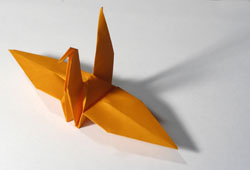
House of folding paper
Origami is more than the art of Japanese paper folding. It can be used as a get-well card, to celebrate or to make a wish.
Utah State University students were recently introduced to the intricate folding techniques by members of The Church of Jesus Christ of Latter-day Saints Students Association International committee.
“When you fold origami, you have to follow the steps,” said Mami Matsumoto, a music therapy sophomore from Saitama, Japan, during the March 24 activity at the Institute of Religion building. “Origami represents Japanese care and patience. It is about culture.”
Matsumoto, who is USU’s current Ms. International, said origami takes time, patience and often, personal instruction. Books can be much complicated to follow.
Origami comes from the Japanese word “oru,” meaning to fold and “kami” for paper. It is widely believed that the art began around the first century AD in China. Paper was so expensive that the pastime was open only for the rich, according to the BBC news service. When paper became cheaper, the art spread to Japan.
For Matsumoto, a crane or “tsuru” is among her favorites. It takes about 30 folds to create a single one. A tsuru represents both wishes and blessings. When someone gets sick in Japan, well wishers will send 999 tiny paper cranes in hopes of a recovery. When the person heals, the friends makes yet another so that the paper gifts total 1,000 – after a legend that has cranes living for a millennium.
Vance Daniels, a junior majoring in political science and LDSSA president, said he was amazed when he learned origami. His first attempt was to make a lily, which requires more than 40 steps.
“I cannot believe people can take just a small piece of paper and make such a neat thing,” Daniels said. “The most difficult thing for me is folding a clear line and following each step.”
In Japan, origami is commonly used for ceremonies.
On July 7, for instance, the Star Festival or “Tanabata” is held. The event is a celebration for the tragic lovers turned into the stars Altair and Vega. The two, separated by the Milky Way, can only meet on this one day, the only time when they are at their brightest.
This is when people write wishes on paper stuck to pieces of bamboo that are placed in their gardens. Japanese folklore says that the wishes will come true.
The second type of origami is recreational folding, said Sachiko Takahira, a junior majoring in special education from Tokyo. Children are taught in kindergarten and elementary school. When they grow up they seldom use the art, except sometimes when folding a letter into a leaf, house or other object when writing to a friend.
Clint Anderson, a sophomore majoring in business administration, said the art is more complicated than it seems.
“Sometimes, I felt lost,” he said.
After 15 minutes, however, he folded the paper into a sumo wrestler. A friend, who made a similar figure, challenged the paper wrestler to a fight. The competition came to a draw.
“It was a great accomplishment for me,” said Anderson of his creation. “But if you lose one step, you will mess up.”
-waimuimou@cc.usu.edu
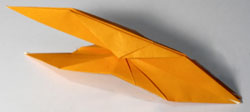
(Photo by Ryan Talbot)
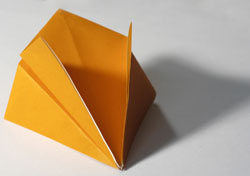
(Photo by Ryan Talbot)
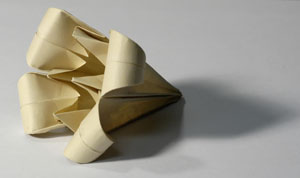
An origami lily takes more than 40 steps to create. (Photo by Ryan Talbot)