
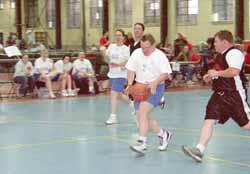
Let the games begin
More than 330 athletes converged onto Utah State University’s campus Saturday, ready to compete with a brimming smile on their faces and the hope of victory in their hearts.
The athletes came to USU from across the state to compete in the Special Olympics Fall Invitational titled, “Dare to Dream.” The event was held Saturday in the HPER and Fieldhouse. The event kicked off at 9:30 a.m. with an opening ceremony and ended with a dance that was held for the athletes.
“I like to have fun,” said Dave Calson, an athlete who competed in the basketball tournament at the games. “And to win the games.”
Athletes came to the games to represent their many different schools, organizations, and
communities.
“People are coming from different schools all around and in the area, and there’s people [from those] communities,” said Sierra Samson, an undeclared sophomore and the volunteer coordinator for the games. “We’ve had a pretty big turnout.”
Special Olympics director Brigham Young, a USU pre-dental senior, said this year’s olympics ran “very smooth.”
“I think it went just as well or better than last year,” he said.
Young was the director of a 30-member management team that operated through the Val R. Christensen Service Center. He said the management team has been planning for the games since the beginning of the year.
Aside from opening ceremonies, swim meets and basketball tournaments were held throughout the day. Even though the event lasted one day, the planning began weeks before the games began.
“Every week we’ve been coming together,” Samson said. “We’ve had people getting the music, and food together and people doing volunteer work. We have done a lot, and a lot of planning has gone into it.”
One of the biggest parts of the games was getting the volunteers together. Volunteers were needed to help set up the event, prepare the food, assist the athletes and help with a wide variety of other tasks.
Gentry Cole, who was the head of publicity for the games, and also a freshman majoring in art education, said, “[To get volunteers] we had to put out fliers in the local establishments and we did things over the radio so that people from the community would come as well. The majority of the volunteers are from the schools, clubs and organizations. There are even people up here that have come from the Salt Lake Valley to help.”
Samson said by day’s end the volunteer sign-up list hosted 261 names, but they’d ran out of paper for them to sign, so she assumed there was a lot more.
Every volunteer who donated their time to the games had different reasons for helping out.
“I love these people,” Cole said. “I love the Special Olympics athletes. There’s such a genuine love from them, and I think that it’s our duty and our job to give that back to them.”
Samson said a friend got her involved in Special Olympics last summer.
“It was amazing to see how excited everyone gets about it, and how pumped the athletes get,” she said. “And also what an impact the volunteers have on the teams. Everyone has such a good time and there’s such a geed feeling here.”
The games not only gave the athletes a chance to have a good time and learn new things, but volunteers, too.
“I learn more from the athletes than I think they learn from me,” said Brooke Richards, a USU Special Olympics basketball coach and sophomore majoring in special education. “Just because I learn that little things in my life are nothing compared to what they have to deal with. They get past the disabilities in their life and it makes me appreciate everything that I have. I think they’re amazing.”
The games also give the athletes a chance to meet new friends, and to learn new things about themselves.
“It gives them confidence and makes them realize that they can do a lot of things,” Richards said. “A lot of them have worked really hard to get here, and they love to play and reach their goals.”
Since the games lasted the entire day, breakfast, lunch and dinner was provided to everyone who was involved.
Julie Pope, a sophomore majoring in social work, was in charge of getting all of the food together for the games.
“I had a committee and we divided up the stores,” Pope said. “We just called and asked for specific things, and told them what we needed. They either gave us a discount or they donated it.”
Cole said, “We get a budget of $2,000 from the school, because we’re a club, and from there on it’s all donations. Most of the food we got discounts on, and some was donated. But $2,000 certainly would not accommodate all of these people.”
There were many people involved in the games on Saturday. Pope said that they were expecting to feed more than 400 people.
One goal of many of the volunteers was that the games would help people understand each other, and to get a better understanding of people.
“I just hope the volunteers know the impact they make on the athletes,” Samson said. “I hope they walk away knowing that they make a difference. For people that haven’t been involved in this, and haven’t come, I just suggest that they come out and give it a try. I promise that you’ll like it and I promise you’ll have a good time.”
The day ended with a victory dance from 6 to 7 p.m. instead of a closing ceremony, to celebrate that everyone there was a winner.
-rbarlow@cc.usu.edu
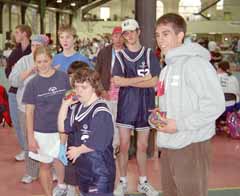
Between games, the Special Olympics athletes were able to take a break and participate in various activities for tickets. (Photo by Jamie Crane)