
Out come the wolves
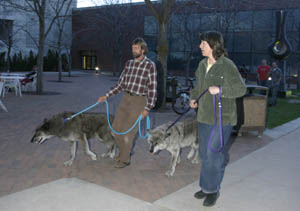
Wolves: The same mythed, little pig-eating animal, was coddled by Utah State University students and members of the community Tuesday evening.
“Mission: Wolf,” a refuge for wolves and wolf-dog cross-breeds located in Colorado, was brought by the Environmental Science, Living With Wildlife class as a service learning project to help teach the public the truth about wolves.
“We got together a group of people that wanted to create a project that would educate the community, as well as ourselves,” wildlife student Tristin Taylor said. “Everyone has a personal connection with wolves.”
The Mission: Wolf’s presentation consisted of a slideshow on the endangerment and reintroduction of wolves in to the United States. After an introduction and careful instructions, such as not being above them, two live wolves were brought in for the audience to visit with.
The attendees created a “wolf circle,” where everyone sits in an enclosed circle. The wolves entered the circle and choose who to interact with.
“To see them upclose was so great. I’ve never really gotten into wolves, until now,” Cache Valley High student Tim Roghaar said.
Magpie and Raven, the two Canadian gray wolves, were originally bred to star in movies, program founder Kent Weber said. They were rejected because they were not male. So they were brought to the refuge.
Weber said that many people have the wrong idea about wolves.
“A wolf, a wolf! A persons first reaction is usually fear. The wolf – it ate the little grandmother, the little pigs … the wolf is the guardian of hell,” Weber said. “Their second comment is ‘how long before he bites you or kills you.”
Wolves are not aggressive or mean, but they do not belong with people, he said.
“Seems to me that most people are confused about wolves,” Weber said. “When people are confused, it is because they don’t understand. When we don’t understand something, we kill it.”
Today there are more than 250,000 wolves and wolf-dog crosses living in captivity, as exotic pets, in the U.S. alone, according to Mission: Wolf.
“We don’t know the difference between wild and domestic,” Weber said.
He organized the refuge after seeing a caged wolf more than 20 years ago.
Weber first introduced wolves into a classroom in 1985. Now he travels in an old Marine Corp. bus, covered in paintings of wolfs, to more than 15 states a year giving presentations.
“It is disgustingly sad that these wolves were born in a cage and can’t be returned to the wild,” Weber said. Unfortunately, because they don’t have the capacity to survive on their own they must remain in captivity.
Wolves are social animals. Magpie and Raven are not afraid of people, he said, which surprised some participants.
“The wolves were so calm,” sophomore Katie Bown said. “I didn’t think that they would be so calm.”
-amandawouden@cc.usu.edu
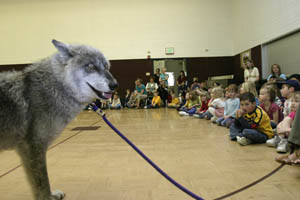
Students at Hillcrest Elementary get an eye-to-eye introduction to Magpie, a female gray wolf. (Photo by Becky Blankenship)
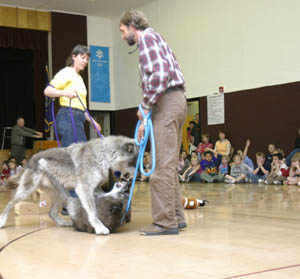
Magpie and Raven, two wolf ambassadors from Mission (Photo by Becky Blankenship)