
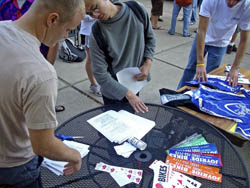
Recruiting an issue for clubs
In addition to the varsity athletic programs, the Utah State Campus Recreation Program houses 16 club sports teams for students to compete against other schools.
Some club sports such as hockey have enough interest to require holding a tryout and then picking the best players from those pools.
“We have always had enough players to put together a viable team,” Utah State hockey team president Michelle Kartchner said. “We usually have 35-50 people try out and we have to cut it down to 28.”
Men’s soccer was in a similar situation this year, having 30 players show up to fill 25 roster spots.
Then there are also sports that have just enough to field teams with little room to spare.
Scott Wamsley, assistant director of Campus Recreation, said that was the case for men’s lacrosse. Last season the club only had about 15 players. With 10 players on the field at a time, Wamsley said that having only five subs wore the team down.
The ultimate frisbee club was in a similar position last year, but have been able to double their numbers for their upcoming season.
“As a consequence of having few people last year, we suffered at tournaments, where we might have nine to 10 players and opposing teams would have around 14,” ultimate frisbee club president Chris Pitts said. “This year we have somewhere between 16-20 people coming out to practice consistently.”
There are even some clubs, such as women’s lacrosse, that don’t have enough to even field a team. The clubs are dissolved until students show greater interest.
In many cases, Wamsley said, participation levels go in cycles. One year there may be more than enough to field a team in a particular sport and then those students may leave and there are not enough players left to carry the club. To ensure that clubs keep bringing in new players, many of the groups use various methods of advertising.
“Our main recruiting methods are word of mouth and Day on the Quad,” water polo club president Paul Wilson said.
These are common tactics used by several of the clubs. In the case of women’s rugby, team president Whitney Doe said that in addition to word of mouth and Day on the Quad, they also have sign-up tables in the Taggart Student Center and they hand out flyers to get the minimum 16 players needed to field a team.
Doe said their main problem wasn’t getting players to come out for the team, it was getting them to keep with it and come to practice.
“One of our limitations is getting people to come out to practice at all and then to stick with it,” Doe said.
She feels that because of the obscurity of the sport, lack of knowledge intimidates people from giving it a try.
“Rugby is not a well-known sport and though no experience is necessary, girls give up before they give themselves a chance to learn,” Doe said. “Lots of people never think about trying to play a completely different sport as well. But if they come out and try it, girls usually find that they really enjoy it.”
Wamsley said that some of the main differences between club and varsity sports are that the players don’t receive any kind of scholarships and the coaches are volunteers.
Players normally find sponsors or hold fundraisers to pay for the needed equipment and necessary expenses. If a team even has a coach, they are just like the players in the sense that they are taking time out of their schedules to be involved in a game they enjoy. There is no monetary benefit for anyone involved.
“They don’t get paid, they do it because they love the sport,” Wamsley said.
– stm@cc.usu.edu