

Show me a Scotsman who doesn’t love Thistle: USU welcomes new live mascot
Highland cattle with heritage from the rolling fields of the Scottish Highlands are taking up residence at Utah State University as the school’s first live mascot in decades. On Oct. 23, USU officially announced the mascot’s name to be Thistle.
“The choice of the Highland cattle connects to the university’s connection to the Scottish theme,” said Abby Benninghoff, head of the Department of Animal, Dairy and Veterinary Sciences. “We’ve got the bagpipes. We’ve got the Scotsman song. We’ve got an official tartan.”
Aggies can expect to see Thistle at sporting games, university events and community events once the cattle are fully trained, according to Benninghoff.
Jessica Oyler, USU vice president and chief of staff, said they hope to have him ready by either the last home football game or by spring. She said the president’s office was inspired to bring live mascots back to USU during one of Brad L. Mortensen’s first meetings as president of USU.
“One of the things that we’ve actually talked a lot about are what are some traditions that Utah State holds dear,” Oyler said. “We started investigating what it would take to get a live mascot, and now we have this.”
According to Oyler, their office has been working with the Department of Animal, Dairy and Veterinary Sciences to determine the best care for the new animals. Brett Bowman, a department lecturer and beef cattle manager, works alongside students majoring in animal science fields to do so.
“He’s super mellow, easy, likes people,” Bowman said.
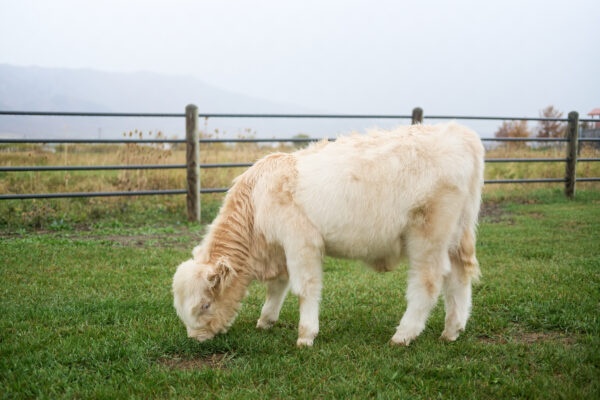
Against the backdrop of the Wellsville mountain range, Thistle No. 1 grazes on a rainy day at the Sam Skaggs Family Equine Education Center on Oct. 22. (Ezra Robertson/The Utah Statesman)
The department encouraged USU to get Highland steers, which Benninghoff described as a particularly calm and cute breed.
“Steers are males that have been castrated, and that is important for their behavior,” Benninghoff said. “If you have an intact male, they’re going to have high amounts of testosterone. They’re going to want to be breeding, and a male with that kind of behavior is much more difficult to handle.”
In working with the office, Benninghoff also explained that cattle and herd animals need companionship and encouraged them to have two at a time.
“This is to support the welfare of these animals — their physical health, yes, but also their mental health,” Benninghoff said.
Benninghoff said that the two cattle they have now are called Thistle No. 1 and Thistle No. 2, and when they retire, their predecessors will be Thistle No. 3 and so on. She added that this will also allow the animals to share the duties of mascot.
Their lifespan, according to Bowman, is around six to eight years. Benninghoff said the cattle are only about eight months old.
six to eight years. Benninghoff said the cattle are only about eight months old.
“They’ll be pampered, so they could live a lot longer than that,” Bowman said. “In fact, I’m sure they’ll retire out somewhere with somebody.”
One aspect of the cattle training process Benninghoff emphasized to the president’s office was the hope to get students involved.
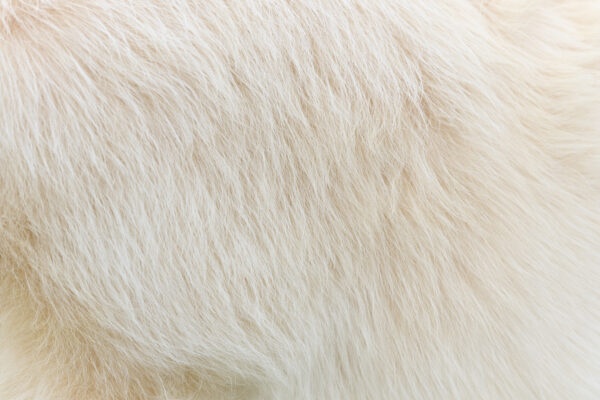
Thistle No. 1’s coat of white fur on a rainy day at the Sam Skaggs Family Equine Education Center on Oct. 22. (Ezra Robertson/The Utah Statesman)
“We want students to be highly involved in the training and taking care of the mascot and involved when the mascot is out in public,” Benninghoff said.
Benninghoff said students will have the opportunity to apply to be Highland Ambassadors, a group of around eight to 10 students that will train, clean and handle the cattle.
“They will need to have training themselves, so they’ll take a class that we offer in our department for animal handling,” Benninghoff said. “They’ll also take a beef cattle production class so that they develop some of that background knowledge, and then they get to do that daily work with those animals.”
These ambassadors will also have the responsibility to communicate with the public, according to Benninghoff.
“They need to be knowledgeable and share information about this particular species of cattle: some of their unique traits, their behavior, how they’re taken care of, the role of livestock in our food systems, you know — big picture,” Benninghoff said.
Before the public can meet Thistle, Benninghoff said they need to be acclimatized to loud environments and lots of people, like the environment of a football game.
“They need to be what we call ‘halter broke,’ meaning you can put a halter around their head and be able to guide them without stressing the animal, without endangering anybody to guide them on and off a trailer,” Benninghoff said.
Benninghoff said they chose the color of Thistle for a specific reason.
“We wanted white to kind of parallel with the blue for Big Blue,” Benninghoff said. “As a running joke, a lot of people have asked, ‘Well, are we going to color the hair?’”
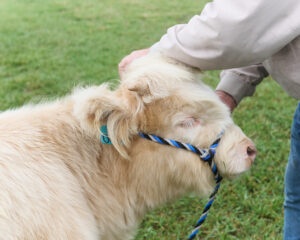
Thistle No. One’s handler puts a halter on him while they take a walk around Sam Skaggs Family Equine Education Center. Oct. 22 (Ezra Robertson / The Utah Statesman)
While Benninghoff said they would avoid dying Thistle’s hair, Bowman said his fur will still be soft and clean due to thorough shampooing and blow-drying done by the ambassadors.
According to Utah State Today, the last time USU had a live mascot was in the 1970s. He was a bull named GUS that stood for “Go Utah State,” but was ultimately retired because he was harder to manage. This, Benninghoff said, is another reason a Highland cow was chosen.
“There is just no denying how stinking cute these calves are,” Benninghoff said.
One of the most important parts of having a live mascot, according to Benninghoff, is the safety and well-being of the animal and those that interact with it.
“We will always keep in mind the welfare of those animals and make sure that the nature of the event, that the frequency of activities for them, doesn’t create stress,” Benninghoff said. “We want these animals to be healthy and happy, both physically and mentally.”
You must be logged in to post a comment.
There are no comments
Add yours