
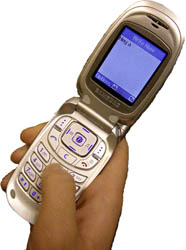
The text big thing
Ten years ago, having a cell phone was a novelty.
Today, it’s become almost an addiction for many students – from college to junior high – and texting has brought the world into a whole new realm of communication and convenience.
“That’s the beauty of texting, you can say what you want to say when you want to say it. I do it because it saves time and I’m often not in a position to call them,” Meredith Jones, a junior majoring in elementary education, said. “I contact people more if I’m texting them. I can be busy all day and stay in contact with people without stopping what I’m doing.”
But whether or not this new form of communication – the bane of many a teacher and professor – is an entirely good thing has yet to be determined.
Even with the added convenience of texting, Jones said she would rather call somebody if she has time.
“I think that if you go out of your way to call, it really shows you care,” she said. “Just dropping them a text message – anybody can do that. If you have time to call, you should do that because those extra couple of minutes can really mean a lot to somebody.”
But Jones said she can still text often. She doesn’t pay her own phone bill, so she wasn’t exactly sure how much texting has run it up, but she said she knows it has happened in the past.
However, Jones isn’t the only one. More and more, students find themselves texting back and there are many reasons and explanations why.
“I don’t know why you don’t pick up the phone and talk,” Dave Swenson, assistant principal at Logan High School, said. “I think sometimes it gives them something to do – it’s a fad. Something that maybe they can do without disrupting places without talking. Something they can do privately.”
One reason could also just be a need to stay connected. Tom Peterson, professor and program director of the interior design department, said it is interesting to see how much students have come to rely on staying connected. He said he thinks students will feel like they will miss out on something if they aren’t connected constantly.
Peterson, who teaches the largest class on campus, frequently deals with students using their cell phones at often inappropriate times. One event for his Creative Arts class especially stood out in his mind. Before the event started, Peterson said he had asked students to turn off their cell phones.
“I had already made the plea to turn off the phones – put them away, things can wait for an hour and a half,” he said. “During the event, I saw several phones light up. I felt bad for those people that they can’t focus on one thing for 90 minutes.
“After the event was over, it was amazing how many phones were out. They were on the phone. It just underscored for me how important that technology is to keeping connected to whoever’s on the other end.”
This new fad has forced many public places to adapt to the changes. It’s not uncommon now before a performance to hear an announcement made asking everyone to turn off their cell phones. Nor is it uncommon to hear junior high teachers telling students if they are caught with a cell phone, it will be taken away.
“When I grew up, I remember when we went to push-button phones,” Swenson said. “Things have always changed. Technology is a wonderful thing. Cell phones are good in a lot of ways. It’s a part of our culture now. We just have to adapt.”
Peterson said society just has to keep adapting with the new technology. As more sophisticated devices come out, he said people need to define when it is and is not appropriate to use cell phones or other devices.
Professors have had to add a “no cell phone policy” to their syllabuses, and despite that, many students are still using their phones during class.
With around 1,000 students in his class, Peterson has seen cell phones out on many occasions. And, he added, he definitely sees them.
“If I walk by, there’s the quick jerk of the arm to put it under the book or something,” he said. “It’s there, it’s obvious, if they think they’re not observable, they’re deluding themselves.”
Swenson also said that text messaging in a classroom can also bring “the element of cheating.” Although he hasn’t seen it at Logan, he knows it could be a real problem. Eric Jensen, testing supervisor for Testing Services at Utah State, said that many testing companies have started to outlaw cell phones during testing time.
Not only would cell phones go off during tests and distract students, phones with picture messaging capabilities brought a whole new element of cheating to the testing field.
“[Texting] makes them an extreme security issue,” Jensen said. “It would be easy to point your phone and click and you’ve got the pages of the test you’re on.”
-aedmunds@cc.usu.edu