
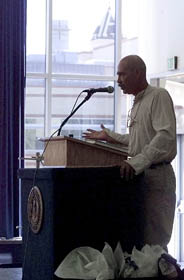
Vietnam veteran says no to war
As part of Hispanic Heritage week, author Manny Garcia spoke to students Wednesday about his book and his life experiences.
Garcia’s book “An Accidental Soldier” tells of his experiences in the Vietnam War and won the Utah Book of the Year award in 2003.
Garcia grew up in Colorado and Utah. He spent his teenage years in Salt Lake City in the 1960s, where he said minorities were rare. But, the scarcity of minorities changed when he joined the army at age 18, he said. In his unit the poor and minorities were over-represented, Garcia said.
“To put it bluntly, there weren’t any rich white kids out there in the jungle with us,” Garcia said.
However, because of the need to survive, those with racial prejudices didn’t speak up as much. The only colors that mattered were olive green and black because the United States wore olive green and the enemies wore black, he said.
“Everyone’s blood was red,” Garcia said quoting his book.
The book paints a “perfectly gruesome horrible story of war,” Garcia said. Garcia shared stories of the first time he killed a person, seeing a friend die, coming home and feeling lost and detached.
Garcia said he is hopeful that the races can continue to blend in daily life across the country and races are closer now than they once were.
“The best golfer in the world is black, for crying out loud. The world has changed,” Garcia said.
Although Garcia said Vietnam has become a point of reference in his life, he does not agree with the war. In fact, he said he threw away all the medals and patches he received as recognition.
“I threw them at the White House. They were lies,” Garcia said.
The government lied to his generation about Vietnam, Garcia said. He calls his book, “An Accidental Soldier”, because he said it was a careless and ignorant decision on his part – one he wouldn’t do again if he had to.
Just like he disagrees with the war in Vietnam, Garcia said to students he also disagrees with the war in Iraq.
“In my case the war in Vietnam had no honor. I believe the war in Iraq has no honor,” Garcia said.
Garcia said he believes there are better solutions in Iraq, and military force should only be used under the terms of clear and present danger. He said he sees the war in Iraq as an ideological war and not a war of necessity like World War II. He said he encourages students to get out and protest if they don’t agree with the war, saying Vietnam came to an end because of the country’s anti-war protests.
“Numbers are hard to ignore. It’s you walking down the street carrying a sign and saying ‘stop it,'” Garcia said.
“If you knew what wars did, you wouldn’t do it,” he said.
Currently a defense attorney in Salt Lake City, Garcia said he was always motivated to get an education by his mother. Garcia’s father had a fourth-grade education and his mother, a sixth-grade education. Garcia said he always wanted more in his life. Garcia once worked at a post office, but later quit and sued his employers. While working with the lawyers, he said he decided to go to law school.
“If I could give students one piece of advice it would be to stay in school, get something from it and then apply it in your life,” Garcia said.
“I think speakers like Mr. Garcia can be very motivational for our students. I think his story is an inspiration and points out how we never really know where life is going to take us, but through hard work, things always seem to work out,” said Juan Franco, vice president for student services.
“I’m very happy people came. I think he was very honest. Even if you don’t agree with what he said, it needed to be said,” Ana Hodgson, Hispanic Student Union president, said.
Hodgson said she was grateful for the union’s faculty advisor David Britt.
“It’s so great to have faculty support. Even though he’s not Hispanic, he truly appreciates the culture,” Hodgson said.
-hilaryi@cc.usu.edu