
USU research could help feed the world
A Utah State University professor, John Carman, has developed plant technology that could aid in ending world hunger and bring revenue to the United States’ agricultural economy.
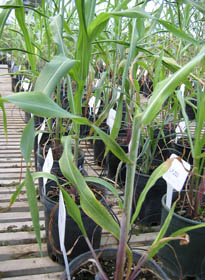
Carman has developed a way to cause base crops – sorghum, wheat and rice – to clone themselves in a process called apomixis.
Carman has been a professor at USU since 1982. He started research on apomixis while working on his doctorate at Texas A&M in 1979 and on June 15, of this year, a U.S. patent was issued to USU for methods in producing apomictic plants.
The Advanced Technology Program (ATP) of the National Institute of Standards and Technology saw the potential for this program in the bi-technology world, and this September awarded a $2 million grant to Gemini Life Sciences, Inc. – the company that will be developing the seeds for commercialization.
“We think it’s a wonderful technology that has a bright future,” said Ross Farmer, chief executive officer of Gemini.
“The easiest thing to comprehend is the increase in yield,” Lindsay Burton, the chief financial officer for Gemini, said.
The hybrid vigor of the plants causes the production amount to be about 10 to 35 percent greater than is usually expected, depending on the plant, Farmer said.
“An apomictic plant can often produce 200 seeds. Plant those seeds and they will become perfect clones of the apomictic mother hybrid. Each of these can produce another 200 clonal seeds. Eventually, you will have enough seed to plant thousands of acres of farmland,” Carman said in a USU press release.
Seeds can be developed that will help plants survive in different climates or agricultural situations, such as rough soil, Burton said. This could benefit developing nations that often don’t have optimum agricultural conditions for farming, he said.
Because the seeds don’t reproduce on their own, they avoid many diseases, mutations and environmental influences that can be associated with natural plants, Carman said.
The increased yield could benefit subsistence farmers who farm solely for their own survival and don’t make aprofit, Carman said.
However, if they use the apomictic seeds, the increase could then be sold for profit, he said.
The objective for the project, as stated on the grant application to ATP is to “develop technologies to stabilize superior crop hybrids by asexual seed production (“self-cloning”), thereby improving yields of major food, feed, fiber and biomass crops and reducing hybrid seed production costs.”
“All you have to do is make one plant and take the seed from that and go,” Burton said.
There will be two types of seeds, one for developed nations to use with intensive, more industrial agricultural systems, and the other for third-world impoverished nations with subsistence farming, Carman said.
“It will make hybrids available to many, many, many more people,” Carole Golden, life science commercialization manager, said.
Golden was responsible for the administrative side in the patent process.
The technology will be licensed to companies to develop hybrids for either one of the two types – the two types will not compete with each other in the commercial market, Carman said.
By providing the manipulated hybrid seeds to the right hands in developing nations, the economic barrier that causes world hunger won’t be as much of an issue, Carman said.
However, specifications on developing countries that might receive the seeds have not been set up yet, Carman said.
For now, researchers will be focusing on development of the seeds for the commercialization stage. The seeds are projected to be ready to market in three years, Farmer said.
“We’re going to be doing a lot of the research at innovation campus,” Carman said.
Research for the development of the seeds will also take place at Boomerang Seeds and Texas A&M.
“All companies that produce and distribute seeds are potential customers of Gemini,” Burton said.
The seeds will first be marketed to manufacturing companies in order to create revenue for Gemini.
The next phase will be to develop special seeds for special locations and work with non-governmental organizations, Burton said.
“There are a lot of channels that will be explored for that,” Burton said of humanitarian work with the seeds. “We need to see how things develop with our clients [developed seed companies] first.”
Gemini wouldn’t have let a rejection from the grant stop the research.
“We’re very committed to it,” Farmer said of apomixis development.
Gemini is a publicly traded company, based in Sugar City, Idaho. The company was created after a merger between Caisson Laboratories, Inc. and Apomyx, Inc., Farmer said.
Research would have persisted, funded on equity, had the grant not been received.
Gemini found out the last week in September that they had been awarded the $2 million grant.
-natandrews@cc.usu.edu