
A day in the life of a veterinarian
Pulling staples, squishy balls and animal toys out of dogs’ stomachs are some of the strangest things Melissa Hillegass has done while working.
As a veterinarian at Mountain View Veterinary Health Center, Hillegass said every day is unique as she works with small and exotic animals and their owners.
“The most challenging and enjoyable part of my job is that since animals can’t tell you what’s going on, you have to figure it out,” Hillegass said.
She discovers how to help animals by doing x-rays and tests.
“I love a mystery. I even read mystery novels in my free time.”
That is, if she gets free time. Hillegass emphasizes that veterinarians have a service profession, and that can mean working late nights, weekends and holidays. Sometimes the profession entails being called at 2 a.m. by drunk people who weren’t worried about their animal and barely noticed it was sick after a couple of days, she said.
“Other times I’m called at 2 a.m. by people who wake up in the middle of the night and their dog is suddenly comatose,” she said. She added veterinarians have to be compassionate in those situations.
“That’s what makes a great vet,” Hillegass said.
Even though she never has the same day twice, Hillegass said a typical days consists of doing things out of three main categories – vaccinations, surgery and treating sick animals. Her favorite animals to work with are the little furry ones, she said.
Although she mostly works with the small animals, she also works with the larger animals at Willow Park Zoo, from the bobcat to the elk. She also works with reptiles and birds, although she doesn’t become as attached to them, she said.
Hillegass said the hardest part of her job is having the ability to treat an animal but not being able to.
“It may be because of their personality or because their owner can’t afford it. Maybe we’re trying to help, but they are trying to eat us,” she said. “Some think it’s putting animals to sleep, and yeah, that’s hard, but you’re giving them a release.”
She said she’ll never put an animal down unless it is very old, ill or has a disease that can’t be treated.
“Never because someone is moving or because the animal doesn’t match the new color of their furniture,” Hillegass said. “A lot of the animals that I put to sleep, I’ve been intimately involved in their lives.”
Hillegass said becoming a vet takes four years of school plus prerequisites. She said she was planning on going into theater when she decided to go to vet school instead during her third year in college. She then had to take chemistry and biology classes.
It’s common for students to switch into vet school, Hillegass said. She said she knew people who did it who had majored in history, psychology, as well as someone who spent 15 years in construction.
“It’s important that people know that its good to be well-rounded,” she said. “Learning communication is important. You don’t have to be a lab rat.”
Hillegrass graduated in May 1995 from Colorado State University and has been a vet ever since. She met her husband, James Israelson, in vet school due to alphabetical seating and now works with him at Mountain View, his focus being large animals.
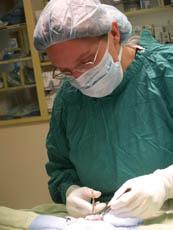
Working with animals is much like working with people, Hillegass said. The vets use many of the same tools and monitor the animals during surgery similar to how a doctor would a human. As she neutered Max, a Shih Tzu, on Monday, Hillegass said she used a $10,000 monitor that kept track of Max’s heart rate, blood pressure, pulse, CO2 level and temperature.
A surgical catheter was inserted into a vein in Max’s right leg, so that just in case he reacted to something, Hillegass and her technician, Becky Reese, could quickly give him medicine. However, there are definite differences in working with animals, Reese said.
“Unlike human medication, we have to deal with a bit more hair,” Hillegass said as she shaved the lower part of Max’s leg so she could insert the catheter. Reese also had to shave the lower part of Max’s stomach so Hillegass would have access to his testicles, where the surgery would take place. She also had to hold Max’s head while Hillegass inserted the IV catheter because “biting does unfortunately happen with this job,” she said.
Reese also said some animals don’t have control over their bladders, so it’s not uncommon for her or Hillegass to be peed on.
Everything must be sterile during surgery, Hillegass said. On Monday Reese rubbed Max’s stomach with iodine and alcohol. Hillegass wore a mask, hair net and rubber gloves as well as a sterile green robe. The areas surrounding the surgical area of Max’s body were covered with blue towels and clamped to the dog’s skin to prevent hair and bacteria getting in the body. He was also laid on a heating pad so he would stay warm through the surgery. Hillegass then begans making small incisions to neuter the dog.
When the procedure was over, Hillegass also did paperwork and updated Max’s medical record on her computer. Then Reese called his owner to set up a time when she could pick him up. They would send him home with pain medication, after his owner paid for the surgery. Hillegass said there is no insurance for dogs like there is for humans, and bills are paid up front.
“Some people say they want to become vets because they don’t want to work with people, but they have to deal with people,” she said, adding that pet owners are generally appreciative for the work vets do.
“I would encourage people to get plenty of exposure if they want to be a vet,” she said. “It’s a lot of hard work, time, energy and money to get here.”
She mentioned a vet also has to be a business person as well as a doctor, and students who graduate from vet school have more options than working in animal clinics. They can also work for pet food companies or help with vaccine production, among several other professions that deal with animals.
For pet owners, Hillegass suggests paying attention to their animal’s health and bringing it in when they suspect something is wrong. She also suggests finding the right vet for them.
“I don’t expect to be the vet for everyone in Cache Valley,” she said. “I think there’s a vet for everybody and everybody for a vet. If they’re not sure where to go, could bring their pet in for a cleaning or nail trim to try the vet on for size and see if there is a personal connection.”
Owners should also pay attention to whether or not the vet is clean and if the employees are friendly, she said. They can also see how their cat or dog reacts. Hillegass also mentioned vet clinics can be certified by the American Animal Hospital Association, which Mountain View is. That means the clinic has advanced monitoring systems, medical records and low mortality rates.
Mountain View Veterinary Health Center is located at 1702 N. 800 East in North Logan. For questions and appointments call 752-8251.
-manette.n@aggiemail.usu.edu